
Backstroke start technique should not look the same at age 11 as it does at age 17. A young swimmer is usually taught to get off the wall safely and get moving. An older swimmer needs to turn that same start into a weapon. The problem is that many clubs teach the start once and never revisit it as the athlete matures.
At the youngest ages, the priority is simple: a clean entry, no false starts, and a controlled position under water. Coaches focus on foot placement on the wall and a strong first pull. That’s the right call for an 11-year-old. But it’s not enough for a swimmer heading toward regional or national competition.
What actually needs to change with age
As swimmers get older and stronger, the underwater phase off the backstroke start becomes far more valuable. Younger swimmers often surface too early because they lack the core strength and breath control to hold a streamline. Older, more trained swimmers can hold that underwater phase longer, and coaches need to start asking a different question: not just “did they get off the wall well,” but “how fast were they underwater, and where did they surface?”
This is where research helps sharpen the coaching decision. Veiga, Roig, and Gómez-Ruano (2016) studied underwater phases at World Championship level and found that in 100m races, underwater distance had little relationship with final time in backstroke — underwater speed mattered more. In 200m races, the pattern flipped: underwater distance mattered more than speed. That’s a real distinction, not a minor detail. A 13-year-old training mostly 50s and 100s should be coached to swim underwater fast off the start. A 16-year-old moving into 200m backstroke needs a different underwater strategy, built around distance, not just speed.
Why this matters for how you coach the transition
Most clubs don’t split these skills. They teach one backstroke start and let the swimmer keep using it as races get longer. That’s a missed opportunity. Coaches who understand this distinction can set different drills for their 100m specialists versus their 200m swimmers, even within the same age group.
The challenge has always been measuring this by eye. A stopwatch can time a start to 15 meters, but it can’t isolate underwater speed from underwater distance, and it definitely can’t show breakout point reliably across dozens of swims a season.
Measuring the backstroke start technique properly
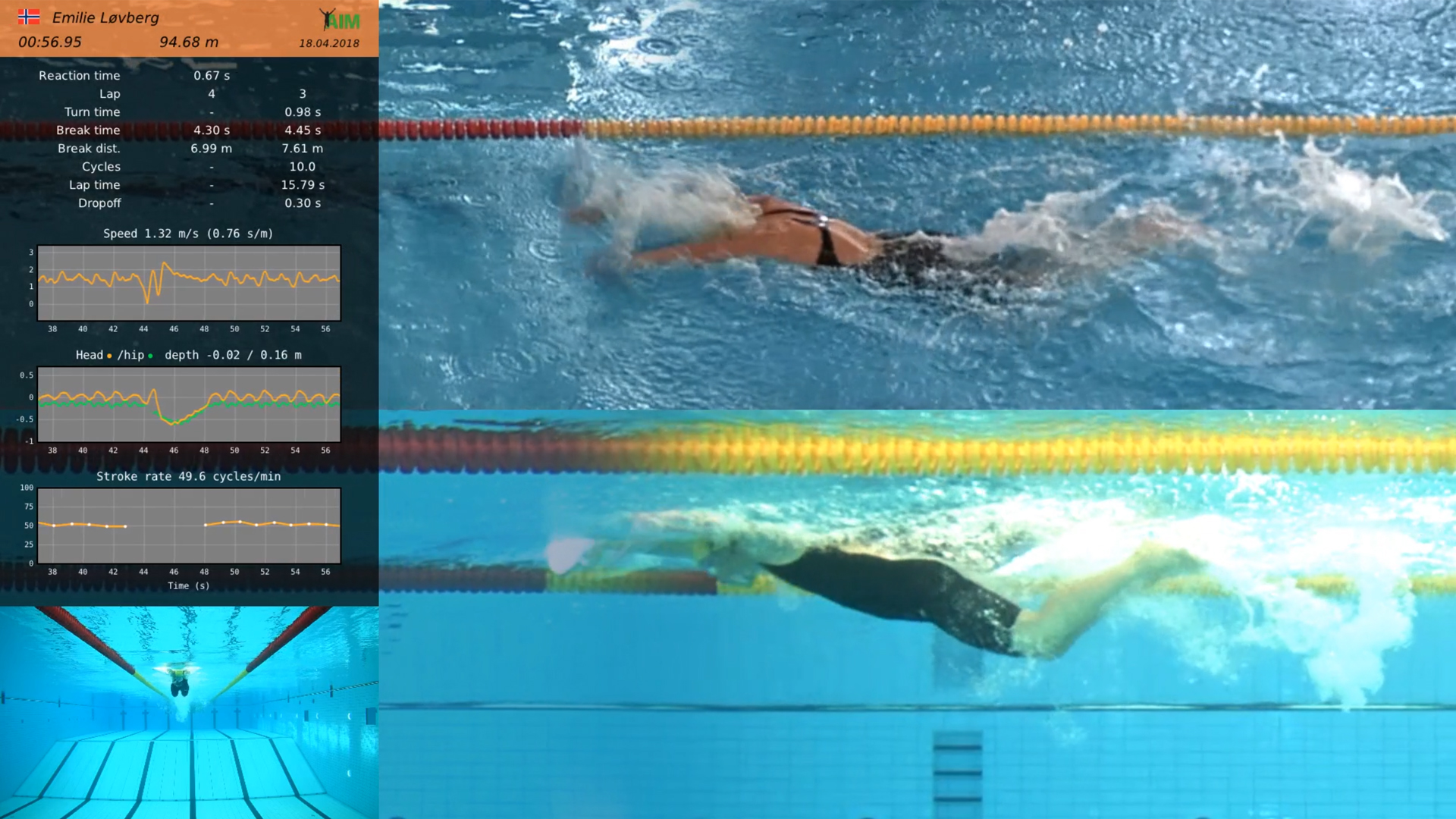
This is where AIM Systems fits in. The system tracks underwater speed after the start, along with breakout time and breakout distance, using fixed underwater and above-water cameras — no wearables, no markers on the swimmer. A coach can pull up a 13-year-old’s start next to their own best time from six months earlier, or line it up against a 16-year-old teammate’s, and see exactly where the underwater phase changed as they matured.
- Breakout distance and breakout time, tracked automatically each swim
- Underwater speed immediately after the start
- Lap-by-lap comparison against the swimmer’s own past times or a teammate’s
That data makes the age-group conversation concrete instead of guesswork. Coaches stop relying on “that looked faster” and start working from actual numbers.
If you want to see how this looks for your own squad, get in touch with AIM Systems — no pressure, just a look at what the data shows.
Frequently asked questions
Should young swimmers focus on underwater speed or distance off the backstroke start?
For shorter races like the 100m, underwater speed matters more than distance, while longer 200m races favor holding underwater distance, according to Veiga et al. (2016).
At what age should backstroke start technique change?
There’s no fixed age, but coaches should adjust the emphasis as swimmers gain the strength to hold a longer underwater phase, typically as they move from short sprint events into 100m and 200m specialization.
How does AIM Systems measure a backstroke start?
AIM Systems uses fixed above- and below-water cameras to automatically capture underwater speed, breakout time, and breakout distance without any wearable sensors on the swimmer.
Sources
- Marinho, D.A., Barbosa, T.M., Neiva, H.P., Silva, A.J., & Morais, J.E. (2020). Comparison of the Start, Turn and Finish Performance of Elite Swimmers in 100 m and 200 m Races. Journal of Sports Science and Medicine, 19(2), 397-407. https://pubmed.ncbi.nlm.nih.gov/32390734
- Veiga, S., Roig, A., & Gómez-Ruano, M.A. (2016). Do faster swimmers spend longer underwater than slower swimmers at World Championships? European Journal of Sport Science, 16(8), 919-926. https://doi.org/10.1080/17461391.2016.1153727
Social Contact