
Many coaches teach underwater technique like there’s one correct model: a fixed stroke rate, a fixed number of kicks, a fixed distance off the wall. Research doesn’t support that. There’s no single underwater technique that every fast swimmer shares, and chasing one template can waste time better spent elsewhere.
Research from the Norwegian School of Sport Sciences (Olstad, Wathne, and Gonjo, 2020) studied short-course 100m breaststroke and found something coaches should sit with. Cycle rate and cycle length during clean swimming were not significantly related to swimming speed. Fast swimmers did not share one common stroke-rate or stroke-length strategy. Each found their own balance.
That matters because so much coaching time goes into standardizing stroke counts and rates across an entire squad. If the fastest swimmers in a well-controlled study didn’t converge on one formula, forcing a single mold onto every athlete on your team is probably misguided.
So what actually predicts speed?
The same study found turns made up the largest chunk of finishing time in short-course breaststroke, about 44%. Clean swimming was next at roughly 39%, then the start at about 11%, and the finish around 5%. Turn-out time and 15m start time were both almost perfectly correlated with final time.
Even more specific: peak velocity and transition velocity — the speed of the first stroke cycle right after surfacing — were strongly tied to how fast swimmers moved through both the start and the turns. That’s the underwater-to-surface transition. It’s a real, coachable skill, and it matters more than hitting a prescribed kick count.
There’s also a fatigue pattern worth knowing. Turn-out time got about 0.38 seconds slower by the final turn compared to the first, in this research. That slowdown came mainly from a weaker push-off and a shorter breakout distance, not from a slower pivot at the wall. If your swimmer’s turns fall apart late in a race, look at breakout distance and push-off power before you touch their turn mechanics.
What this means for how you coach underwater technique
Instead of coaching one rigid underwater template, coach the transition. Watch how fast a swimmer accelerates on that first stroke after breaking the surface. Watch whether breakout distance shrinks as the race goes on.
- Track breakout distance lap by lap, not just once at the start.
- Compare push-off strength late in a race against the first lap, not against a generic standard.
- Let each swimmer’s stroke rate and stroke length settle where it’s fastest for them, not where it matches a teammate.
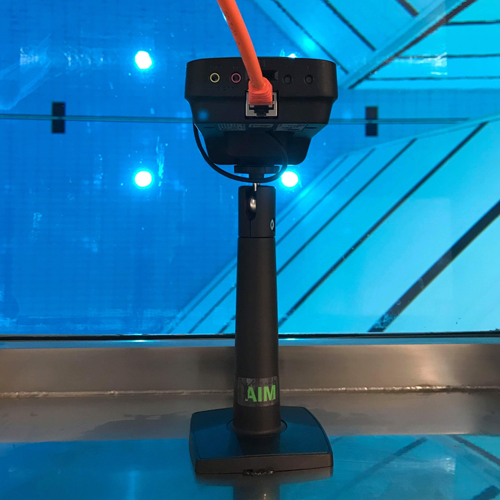
This is exactly the kind of data AIM Systems captures automatically. The system measures breakout time and distance, turn time, and underwater speed after the start, for every lap of a swim, without needing a stopwatch guess from the pool deck. Because its cameras cover both above and below the water, it can track the full underwater-to-surface transition the research points to as genuinely coachable.
A coach can then compare a swimmer’s turn-out and breakout numbers lap-by-lap against their own past best times, instead of against one theoretical ideal that doesn’t actually apply to everyone.
If you want to see what that data looks like for your own swimmers, get in touch with AIM Systems — no pressure, just a look at what’s measurable.
Frequently asked questions
Is there one correct underwater technique all swimmers should use?
No — research on short-course breaststroke found fast swimmers used different stroke rates and stroke lengths, with no single shared strategy.
What underwater metric actually predicts race speed?
Peak and transition velocity right after surfacing were strongly linked to turn and start performance, making the underwater-to-surface transition the key coachable skill.
Why do turns get slower later in a race?
Research found turn-out time slowed by about 0.38 seconds by the final turn mainly due to a weaker push-off and shorter breakout distance, not a slower pivot.
Sources
- Olstad, B.H., Wathne, H., & Gonjo, T. (2020). Key Factors Related to Short Course 100 m Breaststroke Performance. International Journal of Environmental Research and Public Health, 17(17), 6257. https://doi.org/10.3390/ijerph17176257


Social Contact