
Most coaches design practice sets around what they think a swimmer needs. But a swimmer’s weakest phase is often not what it looks like from the pool deck. Building sets around the actual measured weak point, instead of a guess, is how you turn practice time into real gains.

Take breaststroke. Research from the Norwegian School of Sport Sciences (Olstad et al., 2020) looked at short-course 100m breaststroke and found that turns made up roughly 44% of total finishing time. Clean swimming was about 39%, the start about 11%, and the finish just 5%. That means the phase most coaches drill the least — the turn — is often the biggest lever for dropping time.
The same study found something coaches don’t expect: turn-out time got progressively slower across the race, by about 0.38 seconds from the first turn to the last. That slowdown wasn’t from a slower pivot at the wall. It came from a weaker push-off and a shorter breakout distance as fatigue set in. If you only watch the wall touch, you’ll miss it entirely.
Find the Weak Phase Before You Program Around It
This is where guessing fails coaches. A swimmer might look fine on the turn itself but be losing time on push-off strength or breakout distance three turns later. Without lap-by-lap data, that pattern is invisible.
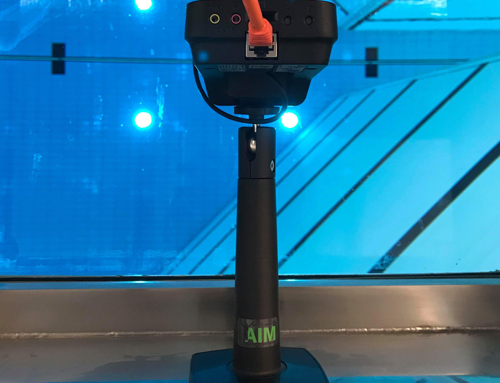
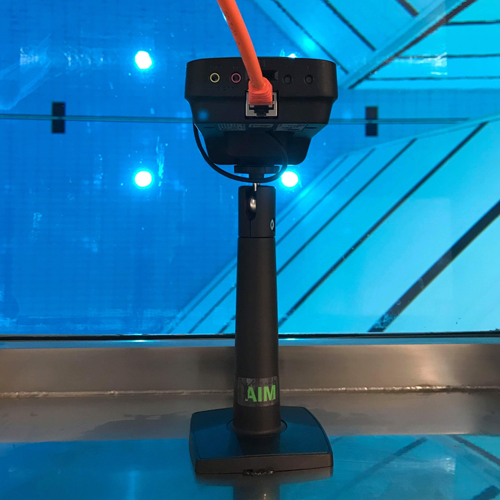
AIM Systems captures exactly this kind of detail. For each lap, it measures turn time, breakout time and distance, stroke count, lap time, and dropoff — the change in lap time compared to the previous lap. Because the system tracks every lap of a swim automatically, a coach can see if breakout distance shrinks on the third turn versus the first, not just eyeball a general “slowdown.”
Once you know the actual weak phase, the practice set writes itself. If breakout distance collapses late in a swim, build sets that fatigue the swimmer first, then isolate push-off and underwater phase quality under that fatigue. If turn time itself is the issue early in a race, work approach speed and rotation drills fresh, without fatigue as a variable.
Why This Beats Guessing by Feel
The same Olstad study found that transition velocity — the swim cycle right after surfacing — was strongly related to how fast a segment went, in both starts and turns. That’s a specific, coachable skill, not a vague “work on turns” instruction.
It also found that stroke rate and stroke length weren’t meaningfully linked to swimming speed on their own. Fast swimmers didn’t share one formula. That’s a good reminder: don’t program a set around a metric just because it’s easy to watch. Program around what’s actually correlated with time, for that swimmer.
- Pull lap-by-lap turn time and breakout distance before writing the next set.
- Compare early-race and late-race turns to see if the drop-off is fatigue-driven.
- Target the specific mechanism — push-off strength, breakout distance, transition velocity — not the phase name in general.
A coach with a stopwatch can time a turn. Only measured, lap-by-lap data shows whether that turn is breaking down at the wall or in the ten meters after it. That distinction changes what you actually put in the pool tomorrow.
If you want to see how this looks with your own swimmers’ data, get in touch with AIM Systems — no pressure, just a look at what’s possible.
Frequently asked questions
How do I know which phase of a swim is actually the weakest?
Compare measured lap-by-lap data — turn time, breakout distance, and dropoff — against the swimmer’s own past times to see where performance actually declines.
Does stroke rate determine how fast a swimmer is?
Research from the Norwegian School of Sport Sciences found stroke rate and stroke length were not significantly related to swimming speed, so it shouldn’t be the default target for a practice set.
Why does breaststroke turn time get slower late in a race?
Olstad et al. (2020) found late-race turn slowdowns were driven mainly by a weaker push-off and shorter breakout distance, not a slower pivot at the wall.
Sources
- Olstad, B.H., Wathne, H., & Gonjo, T. (2020). Key Factors Related to Short Course 100 m Breaststroke Performance. International Journal of Environmental Research and Public Health, 17(17), 6257. https://doi.org/10.3390/ijerph17176257

Social Contact