
Manual video tagging has run university swim programs for two decades. A coach or grad assistant films from the deck, then sits down later and tags turns, starts, and stroke counts by hand. Automated swim race analysis is replacing that workflow, and the reason is simple: it removes the person from the pipeline.

Tools built around manual tagging, like CONTEMPLAS-style systems, still require someone to operate a camera, mark events frame by frame, and export the numbers into a spreadsheet. That works. But it’s slow, and it depends on whoever is holding the camera that day. A missed angle on a turn means a missing data point, permanently.
What automated camera-based race analysis actually removes
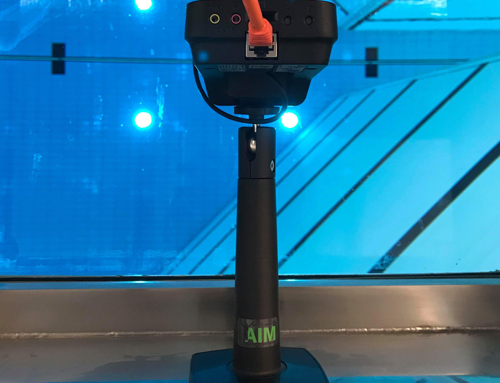
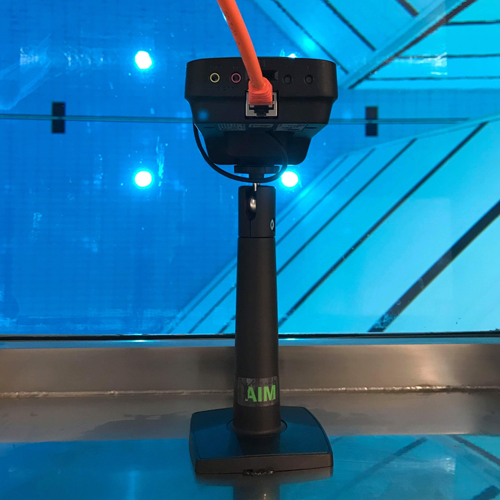
AIM Systems installs a fixed array of cameras along the pool — 11 for a 25m facility, up to 22 for a 50m pool like the setups at Kuortane Olympic Training Center or SCAR in Lund. Five above water, five below, plus a start-angle camera, all synced to the pool’s existing Omega timing system. Nobody operates a camera during a swim. Nobody tags footage afterward.
The swimmer dives in. The system tracks them — one swimmer, one lane, per session — through the entire race. Once they finish, the software automatically synchronizes and stitches every camera angle into one video with data overlaid, plus a full spreadsheet of the extracted stats. For a 50m race, that’s ready in about 2 minutes. For 100m, about 4 minutes. No manual tagging step exists in between.
Why this matters for stroke rate and technique data
Manual tagging systems are only as precise as the person marking frames. Automated tracking captures the same metrics — turn time, breakout distance, stroke count, stroke rate, lap time, dropoff — the same way, every single time, for every swimmer in the program.
That consistency matters most when you’re comparing stroke rate across a season. Craig and Pendergast’s 1979 research established that swimming velocity is just stroke rate multiplied by distance per stroke — meaning a swimmer can hit the same speed with a higher rate and shorter stroke, or a lower rate and longer one. There’s no universal correct number. A coach can only make that call if the stroke rate and lap time data behind it are actually reliable, not eyeballed off a stopwatch or a hand-tagged clip.
Because AIM’s cameras cover the pool continuously, both above and below water, the system also tracks head and hip depth and horizontal speed throughout the swim, with every individual stroke marked on the graph. That level of detail is hard to replicate by hand, no matter how skilled the person doing the tagging is.
What programs give up, and what they don’t
AIM Systems is a fixed installation. It doesn’t travel to away meets, and it only analyzes one swimmer in one lane at a time — it isn’t built for full-field race coverage. What it does replace is the hours a program spends filming and tagging practice swims and time trials, week after week, at home.
Programs can also compare a swim lap-by-lap against a swimmer’s own past times, a teammate’s times, or a manually entered reference time, without anyone building that comparison by hand in a spreadsheet.
Calibration happens once, at installation. There’s no daily setup beyond the roughly 2 minutes it takes to get the pool ready before filming.
If your program is still tagging video by hand, it’s worth seeing what a fixed, automated setup would look like on your deck. Get in touch with AIM Systems to talk through it.
Sources
- Craig, A.B., & Pendergast, D.R. (1979). Relationships of stroke rate, distance per stroke, and velocity in competitive swimming. Medicine and Science in Sports, 11(3), 278-283. https://doi.org/10.1249/00005768-197901130-00011

Social Contact