
Backstroke turns are unique because the swimmer can’t see the wall. They rely on counting strokes off the flags, and that internal clock is easy to wreck if you drill turns the wrong way. When coaches train backstroke turns in isolation, over and over from a dead stop at the wall, swimmers lose the very distance-to-wall judgment the drill was supposed to build.
The fix isn’t to drill less. It’s to drill smarter, in a way that keeps flag-count and speed judgment connected to the turn itself.
Why isolated turn drills backfire
Repeating a turn from a static push-off five meters out teaches a swimmer to execute the flip. It doesn’t teach them to judge distance while fatigued and moving at race speed. As a result, swimmers who look sharp in a wall-drill session still overshoot or undershoot the wall in an actual race.
Distance judgment is a timing skill, not a mechanical one. It has to be trained under the same conditions it will be used: mid-swim, at speed, after a flag count that starts from open water.
Build the approach into every rep
Give every backstroke turn rep at least 10 meters of swimming before the wall. That forces the swimmer to count flags and judge closing speed the same way they would mid-race, instead of just reacting to a wall that’s already close.
- Vary the starting distance so swimmers can’t memorize a single stroke count.
- Mix in fatigue: some reps fresh, some after a hard 100.
- Occasionally call out “no count” to force swimmers to judge purely off feel.
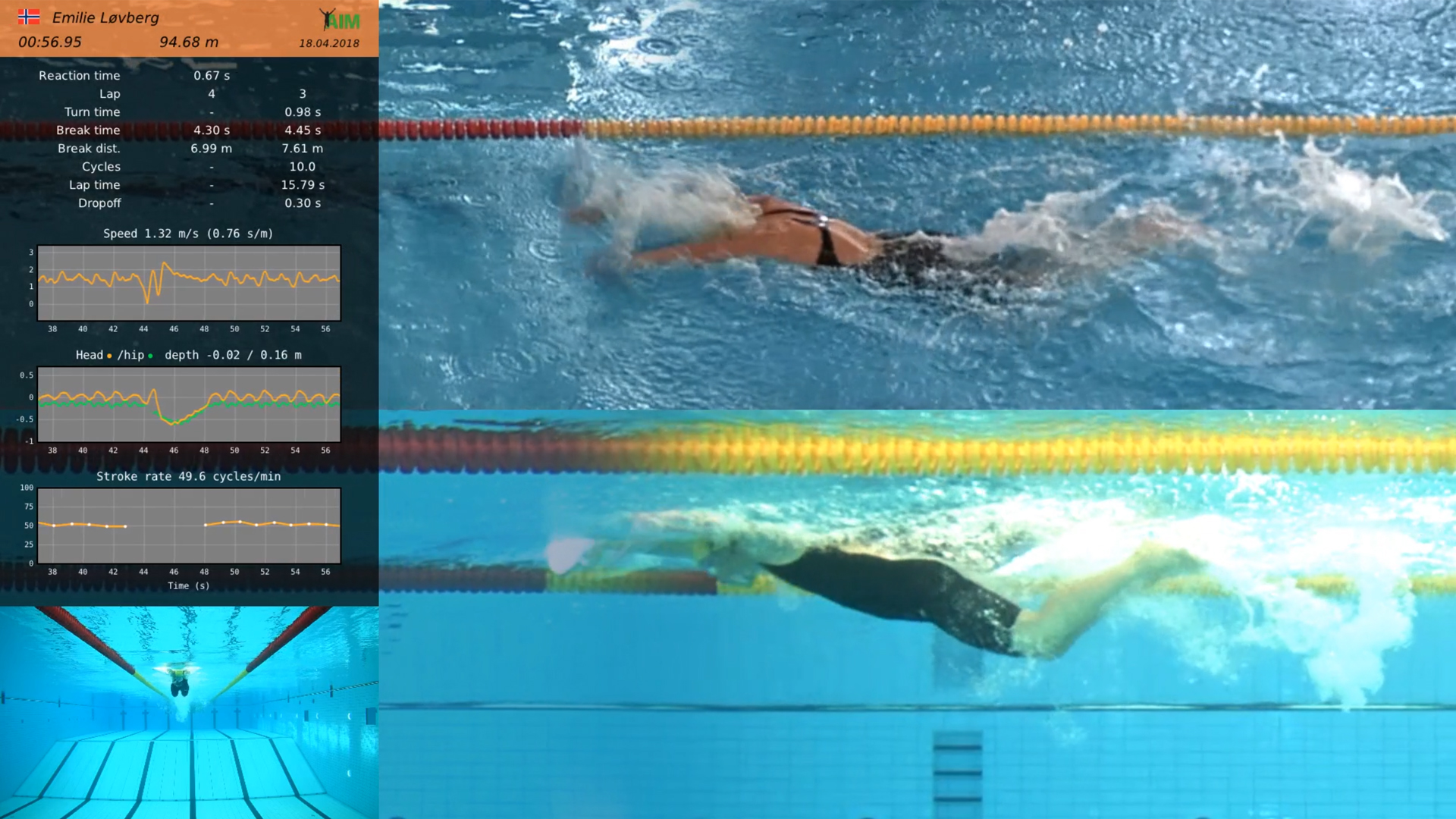
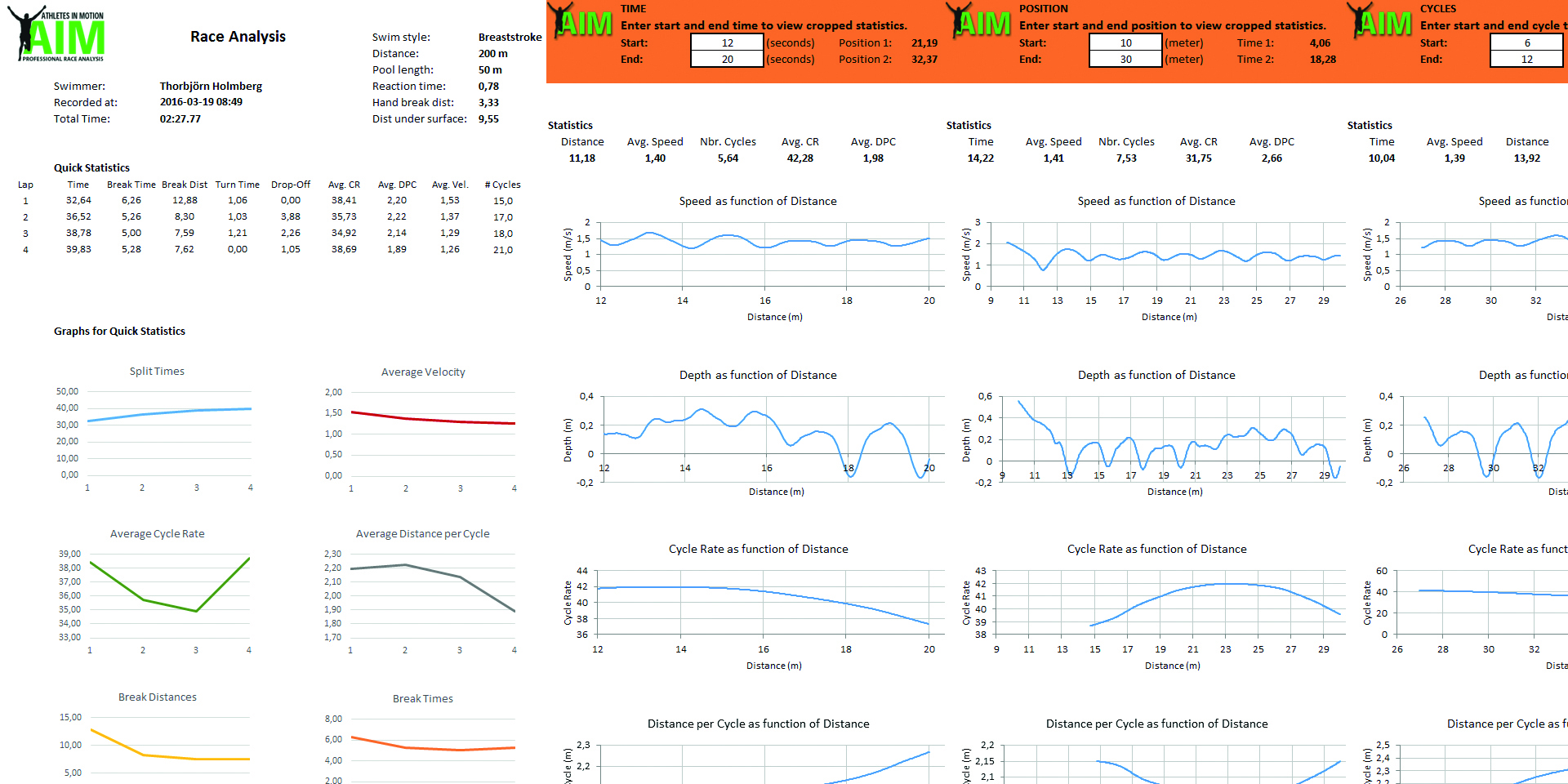
This is also where objective feedback earns its keep. Guessing whether a swimmer’s approach speed or turn time actually improved is hard from the pool deck. AIM Systems captures turn time on every lap automatically — head-entry to push-off for backstroke — along with breakout distance and stroke count into the wall, so a coach can see whether the swimmer’s judgment is actually getting more consistent lap over lap, not just whether one turn looked clean.
Why the surface approach matters more than the underwater phase
Research from Marinho and colleagues (2020), comparing elite swimmers across 100m and 200m races, found something coaches should build turn training around: the underwater phase mainly separates fast starts from slow ones, but surface-swimming technique — the approach into the wall and the swim-out after — is what actually separates fast turns from slow ones. That means the stroke count and pacing judgment on the way into the wall deserve just as much coaching attention as the flip and push-off mechanics.
That’s a strong argument for training the approach, not just the flip. A swimmer with a beautiful turn but poor distance judgment is still losing time before they ever touch the wall.
Track it across a full session, not one rep
A single good turn doesn’t tell a coach much. What matters is whether stroke count into the wall stays consistent across a whole set, and whether turn time holds up as the swimmer tires. AIM Systems’ lap-by-lap data lets a coach compare a swimmer’s current session against their own past times, so drifting distance judgment shows up as a trend, not a guess.
If you want to see how this looks with your own swimmers’ data, get in touch with AIM Systems at https://aimsystems.se/contact/.
Frequently asked questions
Why do backstroke swimmers lose distance judgment when drilling turns?
Isolated turn drills from a static push-off train the flip but not the flag-count and speed judgment needed to time the wall correctly.
What’s the best way to train backstroke turns without ruining wall judgment?
Always give at least 10 meters of approach swimming before the turn so the swimmer must count flags and judge closing speed as they would mid-race.
How does AIM Systems help coaches track backstroke turn consistency?
AIM Systems automatically measures turn time, breakout distance, and stroke count on every lap, letting coaches compare a swimmer’s turns across a session or against their own past times.
Sources
- Marinho, D.A., Barbosa, T.M., Neiva, H.P., Silva, A.J., & Morais, J.E. (2020). Comparison of the Start, Turn and Finish Performance of Elite Swimmers in 100 m and 200 m Races. Journal of Sports Science and Medicine, 19(2), 397-407. https://pubmed.ncbi.nlm.nih.gov/32390734
- Veiga, S., Roig, A., & Gómez-Ruano, M.A. (2016). Do faster swimmers spend longer underwater than slower swimmers at World Championships? European Journal of Sport Science, 16(8), 919-926. https://doi.org/10.1080/17461391.2016.1153727
Social Contact