
Most coaches talk about “the turn” as one thing. It isn’t. Good swim turn coaching splits the wall into three separate phases: the turn itself, the push-off, and the underwater phase. Each one breaks down differently, and each one needs its own fix.
Lump them together and you’ll misdiagnose the problem. A swimmer who looks slow at the wall might have a perfectly fast pivot but a weak push-off. Coach the pivot harder and nothing improves, because that was never the issue.
Why turns deserve this much attention
Research from the Norwegian School of Sport Sciences (Olstad, Wathne, and Gonjo, 2020) looked at short-course 100m breaststroke and found turns made up about 44% of total finishing time. That’s more than clean swimming, which came in around 39%. If turns are nearly half the race, they can’t be coached as an afterthought.
The same study found something coaches often miss: turn-out time got progressively slower across the race, by about 0.38 seconds from the first turn to the last. The cause wasn’t a slower pivot. It was a weaker push-off and a shorter breakout distance as fatigue set in. That’s a push-off and underwater problem, not a turn problem — and it proves why separating the phases matters.
Phase one: the turn
This is the rotation or touch itself — hand-touch to push-off for breaststroke and butterfly, head-entry to push-off for freestyle and backstroke. Coaching here focuses on approach speed, timing of the tuck or touch, and minimizing the pivot itself. AIM Systems measures this directly as turn time, so you can see whether a swimmer is losing time in the rotation or somewhere else entirely.
Phase two: the push-off
This is about leg drive off the wall. A weak push-off shows up as poor underwater speed right from the start of the lap. Because the Olstad study found weaker push-offs — not slower pivots — were driving the late-race slowdown, this is often where fatigue actually shows up first. Coaching cues here are about leg position, wall contact, and streamline timing.
Phase three: the underwater phase
This covers everything from push-off to breakout: kick, dolphin kicks, and the transition back to the surface. The study found peak velocity and transition velocity — the stroke cycle right after surfacing — were strongly linked to how fast the segment was. That transition is a real, coachable skill, not a formality on the way back to the surface.
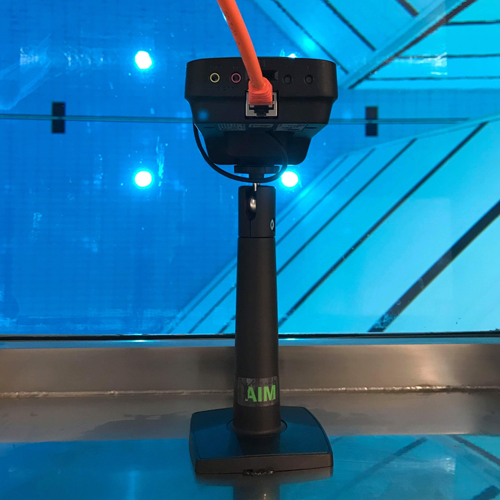
Because this phase happens underwater, it’s the hardest to coach by eye from the deck. This is where AIM Systems’ camera-only tracking earns its keep — five underwater cameras per side on a 25m installation, more on 50m pools, capture breakout distance, breakout timing, and underwater speed without any sensor on the swimmer.
Coaching each phase on its own data
Once you separate the phases, you can compare a swimmer’s turn time, push-off, and breakout distance lap by lap against their own past times. That’s exactly what AIM Systems’ comparison tracking is built for — spotting which specific phase degrades first, race after race, instead of guessing from a stopwatch.
- Turn time: how efficient is the actual rotation or touch?
- Push-off: how strong is the leg drive off the wall?
- Underwater phase: how fast and how far before breakout?
Treat these as three separate conversations with your swimmer, not one. The data will tell you which one to have first.
If you want to see how this looks with your own swimmers’ wall data, get in touch with AIM Systems.
Frequently asked questions
What are the three phases of a swim turn?
The turn (touch or rotation), the push-off (leg drive off the wall), and the underwater phase (kick and transition to breakout).
Why do turns get slower later in a race?
Research on short-course breaststroke found turn-out time slowed by about 0.38 seconds from the first to last turn, mainly due to a weaker push-off and shorter breakout distance, not a slower pivot.
How does AIM Systems measure underwater turn performance?
It uses fixed underwater cameras to capture breakout distance, breakout timing, and underwater speed automatically, without any sensors on the swimmer.
Sources
- Olstad, B.H., Wathne, H., & Gonjo, T. (2020). Key Factors Related to Short Course 100 m Breaststroke Performance. International Journal of Environmental Research and Public Health, 17(17), 6257. https://doi.org/10.3390/ijerph17176257


Social Contact