
Here’s the blunt answer: a swimmer’s fastest speed in an entire race happens in the first 15 meters, right off the start. No stroke later in the swim comes close to matching that initial underwater speed. And yet most practice time goes toward stroke mechanics in the middle of the pool, not the explosive window where the swimmer is actually moving fastest.

Think about what happens physically. The swimmer leaves the block with a dive, enters the water, and travels underwater before any stroke begins. There’s no drag from arm recovery, no breathing, no stroke cycle slowing things down. It’s pure, unresisted glide and kick. That’s why underwater speed after the start is consistently the highest velocity measured anywhere in a race.
Why the first 15 meters matters more than coaches treat it
If the fastest speed in the race happens in the first 15 meters, then losses there are expensive. A swimmer who enters the water poorly, kicks weakly off the wall, or surfaces too early is giving up time at the single fastest point of the race. That time is almost impossible to make up later, because no other phase of the swim reaches the same velocity.
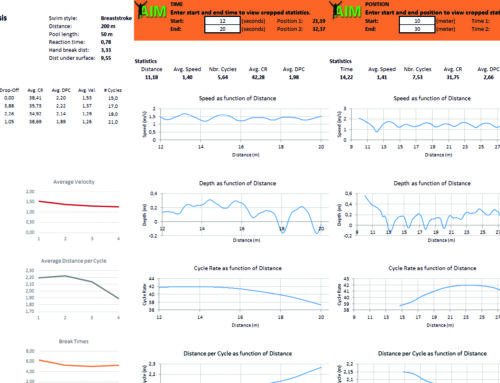
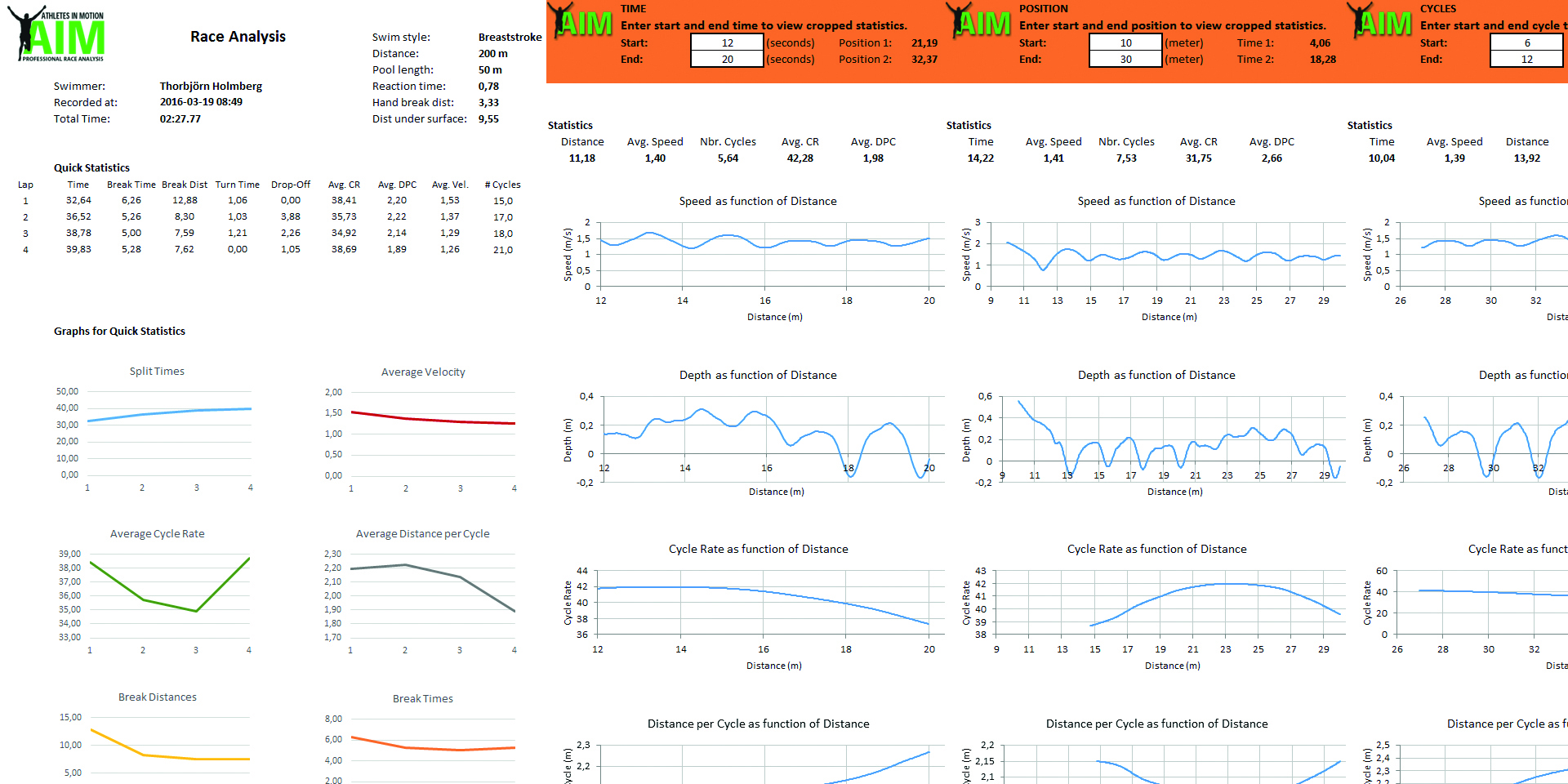
This is exactly why AIM Systems measures entry/landing distance and underwater speed after the start as separate, specific data points. A coach doesn’t need to guess whether a swimmer’s start was fast. The spreadsheet shows the number, lap by lap, race by race.
The pull-out and transition get overlooked too
Research from the Norwegian School of Sport Sciences (Gonjo & Olstad, 2021) looked at elite versus sub-elite breaststrokers across a full 100m time trial using the AIM race analysis system. The surprising part wasn’t the start itself — it was what came after. Elite and sub-elite swimmers showed no measurable difference in the pull-out phase or in the very start of the swim-out that follows it.
The researchers modeled what would happen if swimmers swapped in their own best pull-out and transition segments for their weaker ones. Two swimmers with nearly identical overall times could both have gone under 60 seconds. That’s a significant gain from a phase most coaches don’t train directly. It suggests the pull-out and transition are under-coached even among strong racers — not because they’re unimportant, but because attention tends to drift toward stroke count and mid-pool mechanics instead.
What a coach can actually do with this
Start by treating the first 15 meters as its own skill, not an afterthought before “the real swim” begins. Film the start and pull-out specifically. Compare entry distance and underwater speed against the swimmer’s own best race, not just a stopwatch split.
With a fixed camera installation, AIM Systems captures this automatically — above and below water — and produces a stitched video plus full spreadsheet after the swim. For a 50m race, that complete breakdown is ready in about 2 minutes. There’s no need to eyeball the start from the pool deck and guess.
- Track entry/landing distance after the dive
- Measure underwater speed through the first 15 meters
- Compare pull-out and transition times against the swimmer’s own fastest race
If you want to see how this looks with your own swimmers, get in touch with AIM Systems — no pressure, just a look at what the data shows.
Sources
- Gonjo, T., & Olstad, B.H. (2021). Differences between elite and sub-elite swimmers in a 100 m breaststroke: a new race analysis approach with time-series velocity data. Sports Biomechanics. https://doi.org/10.1080/14763141.2021.1954238

Social Contact