
A good stroke-rate target isn’t a number from a chart. It’s a number pulled from the swimmer’s own best swims.
Too many coaches set stroke-rate targets off generic benchmarks — “elite freestylers hold 80-90 strokes per minute” or similar. That’s a starting point, not a target. Every swimmer has a different stroke length, distance-per-stroke tendency, and fatigue curve. The only stroke-rate target that actually helps is one built from that swimmer’s own data.
Why a generic stroke-rate target fails
Stroke rate on its own doesn’t tell you much. A swimmer can hold a high rate and still slow down if their distance-per-stroke collapses. Conversely, a swimmer can drop rate late in a race and still hold pace if their technique stays efficient.
This is why comparing a swimmer only to an outside standard is risky. Gonjo and Olstad’s 2021 review of race-analysis research found that even basic definitions vary widely across studies — the turn segment alone has been defined seven different ways in published literature. If researchers can’t agree on consistent definitions, a coach shouldn’t lean on borrowed numbers from unrelated swimmers either.
Build the target from lap-by-lap history
Instead, look at the swimmer’s own past races. Pull stroke rate lap by lap from their best times at the target distance. Find where rate holds steady and where it drops. That drop point is usually where technique breaks down, not where effort runs out.
From there, you can set a rate target for each lap of the race, not just one number for the whole swim. A 200m swimmer might target a different rate in lap one than in lap four. That’s a realistic target, because it reflects what that swimmer’s body actually does when they’re swimming well.
Track it automatically, lap by lap
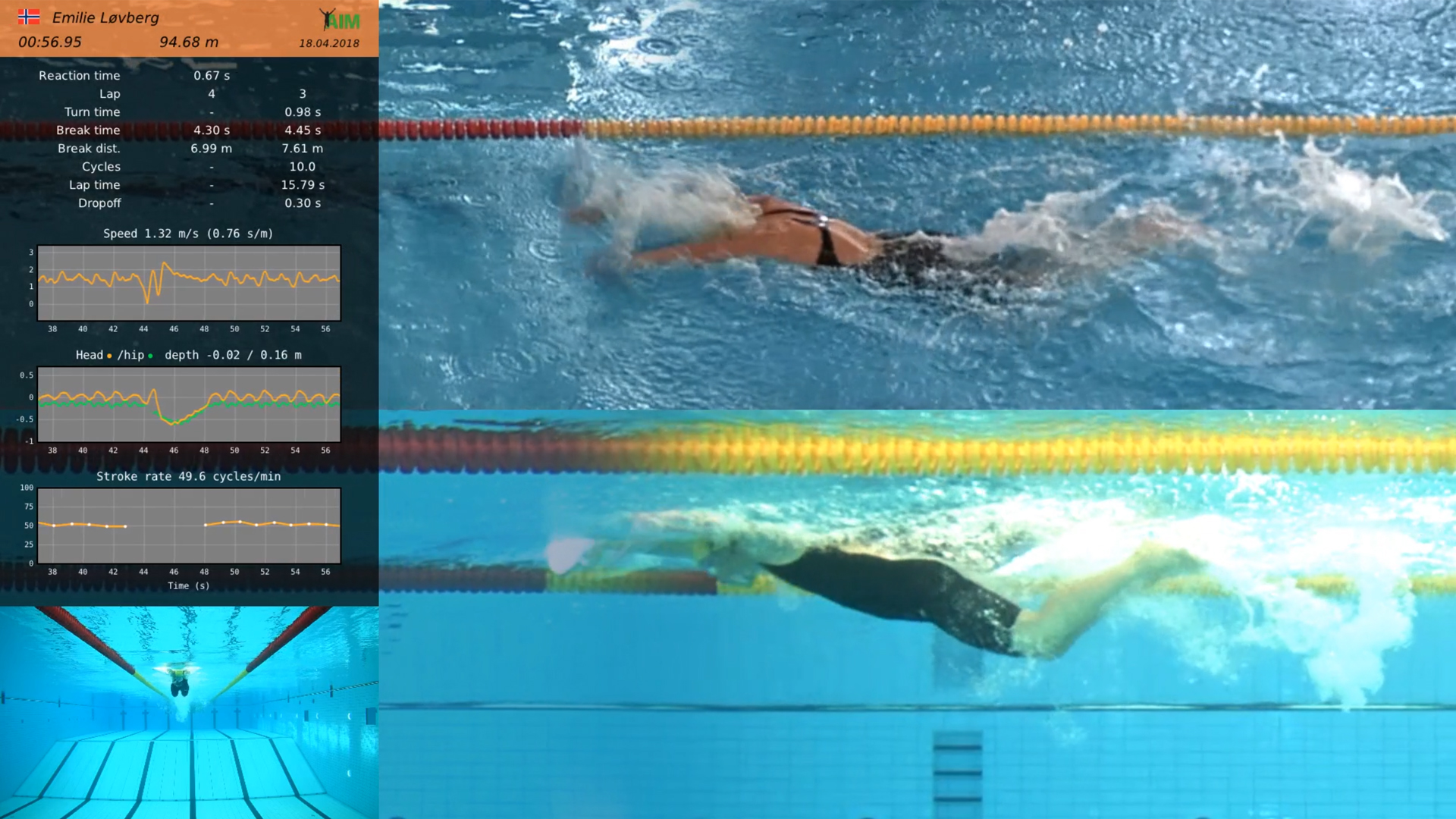
This is where manual stopwatch tracking falls short. Counting strokes by eye across four laps, for four strokes, for a whole squad, isn’t sustainable. AIM Systems tracks stroke rate continuously through an entire swim, with every individual stroke marked on the speed and stroke-rate graph.
Because the system also captures stroke count, lap time, and dropoff for the same swim, you can see exactly how stroke rate connects to pace lap by lap. And because AIM Systems compares a swim against that swimmer’s own past top times automatically, you can check whether today’s stroke rate matches the pattern from their best race — not a guess, an actual comparison.
That comparison is the real value. A stroke-rate target only means something if you can check it against real swims, session after session, without re-measuring everything by hand.
Practical steps for next week
- Pull stroke rate from a swimmer’s three best recent swims at the race distance.
- Mark where rate is stable and where it drops.
- Set a lap-by-lap rate target, not one flat number.
- Recheck after every timed swim, and adjust as the season progresses.
Stroke rate isn’t a fixed number to chase. It’s a pattern specific to each swimmer, and it changes as they get fitter and more efficient. The target should change with it.
If you want to see how AIM Systems captures stroke rate and the other lap-by-lap metrics automatically, get in touch — no pressure, just a conversation about your pool.
Sources
- Gonjo, T., & Olstad, B.H. (2021). Race Analysis in Competitive Swimming: A Narrative Review. International Journal of Environmental Research and Public Health, 18(1), 69. https://doi.org/10.3390/ijerph18010069
Social Contact