
Age-appropriate technical benchmarks mean judging a swimmer’s turn and breakout numbers against their own stage of development, not against a senior standard they haven’t grown into yet. A 12-year-old’s turn time should be compared to other 12-year-olds, not to a national-team swimmer’s splits. Get this wrong, and you either panic over “slow” numbers that are actually normal for the age, or you miss real technical gaps because a swimmer’s raw time looks fine.
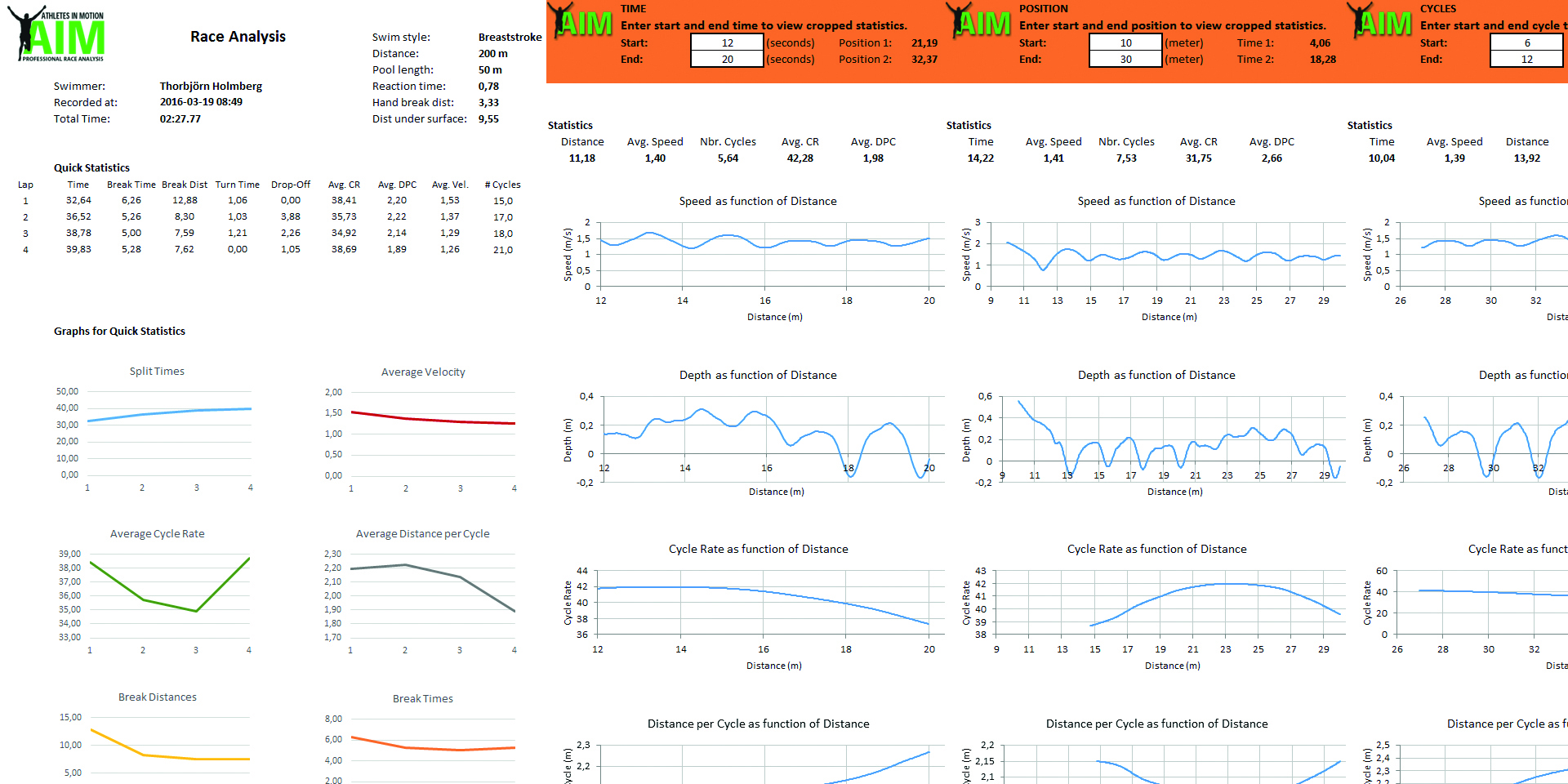
Turn time and breakout distance are two of the clearest technical markers a coach can track. Turn time covers head-entry (or hand-touch, for breaststroke and butterfly) to push-off. Breakout distance is how far a swimmer travels before their head surfaces after the wall. Both change a lot as swimmers grow, get stronger, and develop underwater skill — so a single fixed target across all ages doesn’t work.
Why one standard fails across age groups
A 10-year-old and a 16-year-old swimming the same stroke will show very different turn mechanics. Strength, limb length, and lung capacity all affect how long a swimmer can hold a streamline or how far they travel underwater. As a result, setting one breakout-distance target for an entire club age group usually either demoralizes younger swimmers or sets the bar too low for older ones.
Instead, build benchmarks in bands: 10-and-under, 11-12, 13-14, and 15-plus, for example. Within each band, track turn time and breakout distance as a range, not a single number. This gives you something realistic to coach toward at each stage, and it gives swimmers a benchmark they can actually beat.
What the research says about adapting technique, not just timing
Research from the Norwegian School of Sport Sciences (Olstad et al., 2021) looked at breaststroke underwater pull-outs across 50m, 100m, and 200m starts. The coordination pattern between the arms and legs during the pull-out stayed consistent regardless of race distance. What changed was glide duration — swimmers glided longer in the 100m and 200m than in the 50m, adjusting speed through the simpler variable of gliding rather than the more complex timing of limb coordination.
That’s a useful principle for age-group benchmarks too. Younger or less experienced swimmers often benefit more from adjusting glide and timing of breakout, rather than being pushed to overhaul limb coordination before they’re ready. The study also found a consistent sequence worth noting: the dolphin kick finished before the arm pull-out began, with roughly a 0.4-second gap between the two. That’s a workable reference point, though the research also found real individual variability — so it’s worth coaching per-swimmer rather than forcing everyone into the same gap.
This lines up with the parametric training approach associated with coach Alex Nikitin, who worked with Genadijus Sokolovas to build age-appropriate training parameters for developing swimmers. Part of that philosophy warns against over-relying on measurable targets at the expense of skill development — a good reminder that benchmarks should guide coaching conversations, not replace them.
Turning data into age-banded benchmarks
This is where consistent measurement matters. AIM Systems captures turn time and breakout distance automatically on every lap, using fixed cameras — no stopwatch estimates, no guesswork on breakout distance. Over a season, that gives you real age-group data from your own swimmers, not a borrowed standard from somewhere else.
- Pull turn time and breakout distance for every swimmer in an age band, across several meets.
- Set the benchmark as a range — not a single cutoff time.
- Revisit the bands each season as your group’s data grows.
If you want to see how this looks with your own squad’s data, get in touch with AIM Systems — we’re happy to walk through it.
Sources
- Olstad, B.H., Gonjo, T., Conceição, A., Šťastný, J., & Seifert, L. (2021). Arm-leg coordination during the underwater pull-out sequence in the 50, 100 and 200 m breaststroke start. Journal of Science and Medicine in Sport. https://doi.org/10.1016/j.jsams.2021.08.006
Coaching Perspectives Referenced
- Alex Nikitin — Co-developed “parametric training” with Genadijus Sokolovas (then USA Swimming’s Director of Exercise Physiology) — a system for setting age-appropriate training volumes and career-stage training parameters, aimed at avoiding both over-training young swimmers and under-training as they mature. (Desert Thunder Aquatics — About DTAC (parametric training description), “I Don’t Get It” podcast — episode with Alex Nikitin)


Social Contact