
Automated race analysis captures turn time, breakout distance, stroke rate, and underwater speed straight from fixed cameras, with no one sitting at a laptop tagging video. Manual analysis relies on a person scrubbing footage and clicking timestamps by hand. For university and national team programs running swimmers through hundreds of reps a week, that difference determines how much usable data your staff actually gets.
Most “swim software” search results mix up two very different categories. Meet-management and roster tools handle entries, heat sheets, and results. Video analysis tools like hand-tagged systems help a coach mark up footage after the fact. Neither is built to automatically produce lap-by-lap biomechanical data during training. That’s a separate category, and it’s worth knowing what to look for.
What Hand-Tagged Video Analysis Actually Requires
A staff member films the swim, then reviews it frame by frame. They mark turn walls, breakouts, and stroke counts manually. This works fine for one swim reviewed occasionally. It doesn’t scale when you want every swimmer’s every turn tracked across a full season.
The bigger issue is consistency. One analyst’s read on “breakout” might differ from another’s by a few frames. Over hundreds of swims, that noise adds up and makes trend data unreliable.
What Automated Race Analysis Changes
AIM Systems installs fixed cameras permanently at a facility — 11 cameras for a 25m pool, up to 22 for a 50m pool, split above and below the waterline. The system integrates with the facility’s existing Omega timing system, pulling touchpad data for timing accuracy. There’s no wearable sensor and no marker on the swimmer. It’s markerless, camera-only tracking, one swimmer in one lane per automated session.
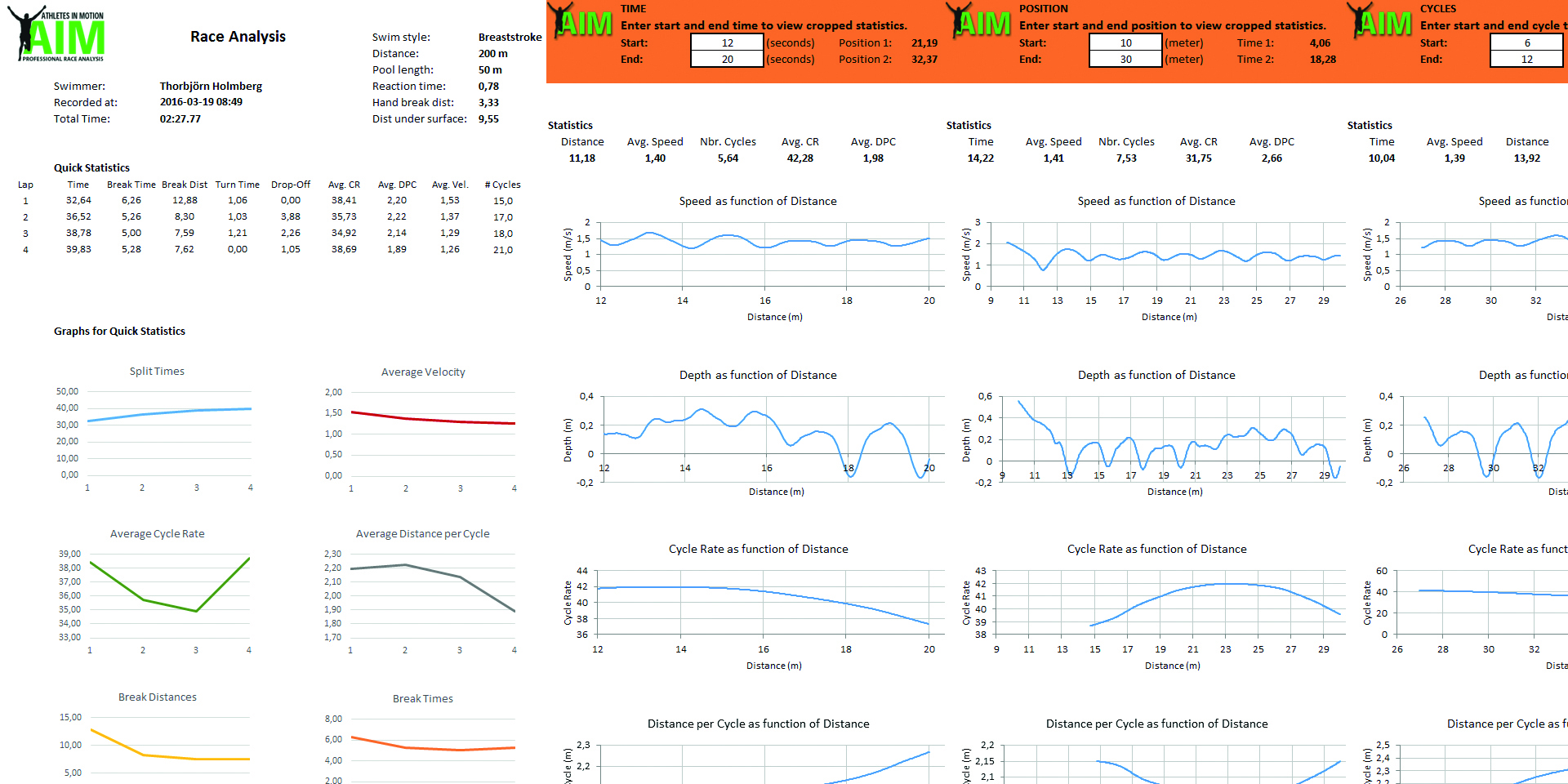
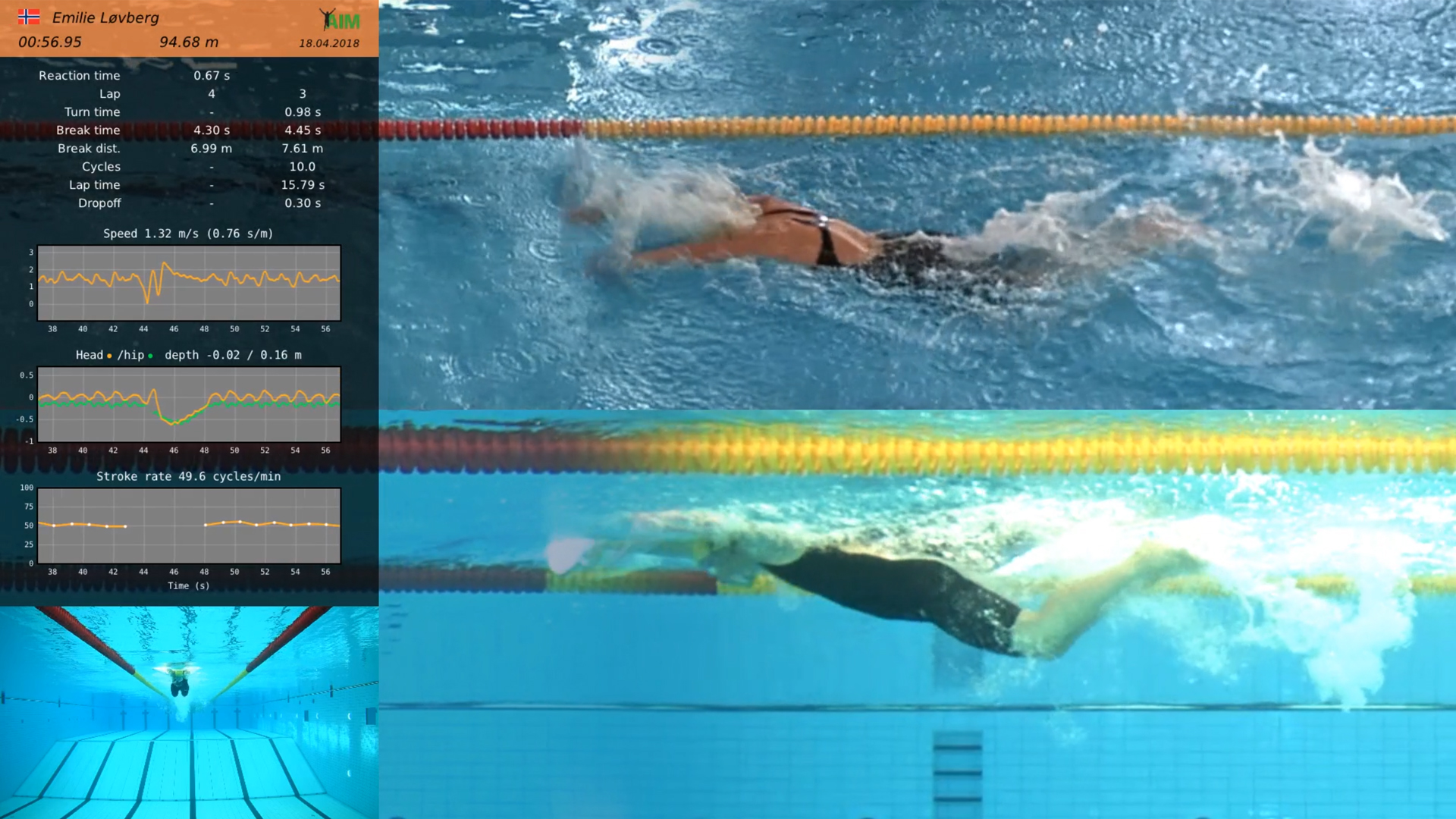
For that swim, it automatically outputs a stitched video with data overlaid, plus a spreadsheet of statistics: turn time, breakout time and distance, stroke count and rate, lap time, dropoff between laps, start entry distance, and underwater speed off the wall. Continuous graphs track horizontal speed, head and hip depth, and stroke rate through the whole swim, with each stroke marked.
Because it’s camera-only, it can measure things a stopwatch or a hand-tagging process can’t do reliably — like exact breakout distance or underwater speed immediately off a start. That’s the real gap between automated race analysis and manual video review.
What to Ask Before You Buy
- Does the system integrate with your existing timing system, or does it require replacing it?
- Does it produce raw video only, or structured data you can compare across swimmers and seasons?
- Can it compare a swim lap-by-lap against a swimmer’s own best times, another swimmer, or a manual reference time?
- Is it a fixed installation for training, or something you’d need to haul to meets?
AIM Systems is a fixed installation — it doesn’t travel to competitions. It’s built for the daily training environment at facilities like Kuortane Olympic Training Center, INCEP Paris, the Norwegian Institute of Sport, and SCAR in Lund. If your program trains the same swimmers at the same pool day after day, that’s exactly where automated capture pays off most.
Manual video analysis still has a place — reviewing technique outside a formal timed swim, or coaching a stroke change on the pool deck. AIM Systems also supports that through a manual mode for streaming or recording without automated analysis. But for turning training data into a real season-long comparison tool, automated capture is a different category entirely.
If you’re weighing options for your program, it’s worth a conversation. Reach out to AIM Systems and we can walk through what fits your facility.
Frequently asked questions
What is the difference between automated and manual swim race analysis?
Automated race analysis uses fixed cameras to capture and calculate metrics like turn time and stroke rate without human input, while manual analysis requires a person to review footage and tag data points by hand.
Does AIM Systems work with existing pool timing systems?
Yes, AIM Systems integrates with a facility’s existing Omega timing system and uses its touchpad data for timing.
Can AIM Systems track multiple swimmers in a race at once?
No, the automated analysis mode tracks one swimmer in one lane per session, not multiple lanes simultaneously.
Social Contact