
Markerless AI video analysis measures stroke mechanics directly from footage — no wearable sensors, no markers on the skin, no equipment on the swimmer at all. The system tracks the swimmer’s body through the water using computer vision, extracting stroke rate, underwater phase details, and technical breakdown under fatigue from the video itself. For coaches, that means the feedback comes from what actually happened in the pool, not from a device the swimmer had to wear correctly.
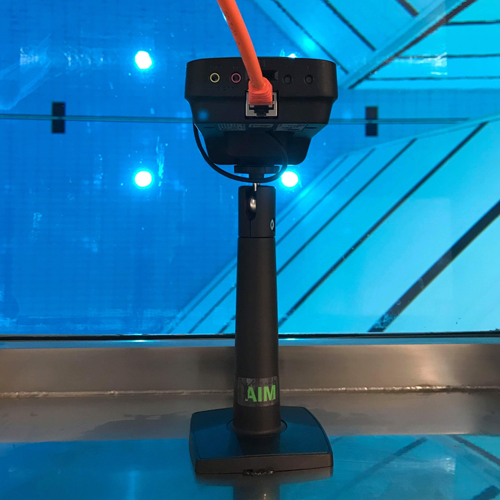
This matters more than it sounds. Wearable-based systems — accelerometers strapped to a wrist, sensors clipped to goggles — introduce two problems every coach has run into. First, the swimmer has to remember to wear it, charge it, and place it correctly, every session. Second, the device itself can change the swimmer’s feel in the water, especially underwater where drag and stroke path matter most. A sensor on the forearm is a small addition to the exact surface the coach is trying to measure cleanly.
Camera-only, markerless analysis removes both problems. The swimmer swims. Nothing is attached. The cameras and software do the rest.
What Markerless Analysis Actually Captures
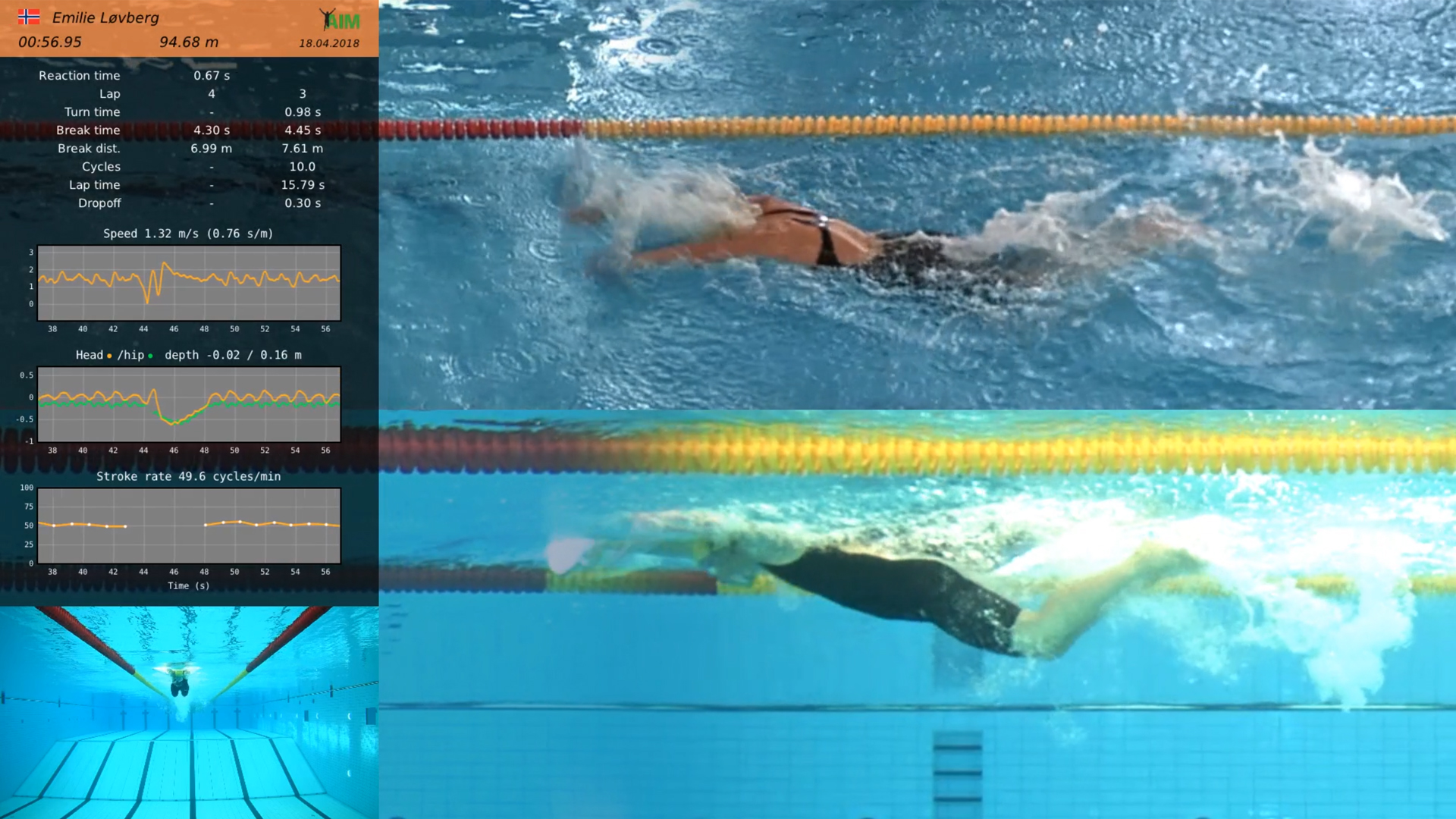
“Markerless” doesn’t mean less precise — it means the precision comes from computer vision instead of hardware on the body. AIM Systems’ pipeline reads:
- Underwater phase detail — kick count off the wall, breakout distance, and entry angle, all tracked frame by frame
- Wall velocity — how fast a swimmer actually leaves the wall, not just their split time
- Technical fatigue — where stroke mechanics start to break down late in a race or a hard set, visible directly in the footage rather than inferred from a single sensor reading
This is the part sensor-based systems genuinely struggle with. An accelerometer can tell you stroke rate changed. It can’t show a coach the entry angle degrading on the third 100 of a fatigue set, or that a swimmer’s breakout distance is shrinking as the session goes on. Camera-based tracking gives you the mechanics themselves, not a proxy for them.
Why This Is a Real Alternative to Wearable Systems
Coaches comparing camera-based tools to wearable or sensor-based options are often really asking one question: does removing the hardware cost me accuracy? With markerless video analysis, it doesn’t — it changes what’s practical to measure at scale. You can’t put sensors on an entire squad for every session. You can point cameras at a lane and run every swimmer through it, every day, without gear logistics.
AIM Systems runs this as a full pipeline: swim, then exported film with data overlays and a complete dataset, in under two minutes, with no manual processing. That includes broadcast-style race overlays for review sessions and personal best tracking that builds automatically as swimmers pass through. It’s installed at the Norwegian Institute of Sport, Kuortane Olympic Training Center in Finland, INCEP Paris, and SCAR — the Swedish Center for Aquatic Research in Lund. Built for daily training environments, not adapted from a lab setup.
If you’re evaluating stroke analysis tools and wearables have been the sticking point — for younger swimmers, for large squads, or just for keeping the water feel honest — it’s worth seeing what a camera-only setup actually captures. Get in touch and we’ll walk through it with your own footage.
Social Contact