
Most tools for measuring turn speed require something attached to the swimmer. A tethered speedometer means a belt and cable. An IMU means a strapped-on sensor near the hip or wrist. Both work, but both change what the swimmer feels in the water — and both take time to set up between swims.
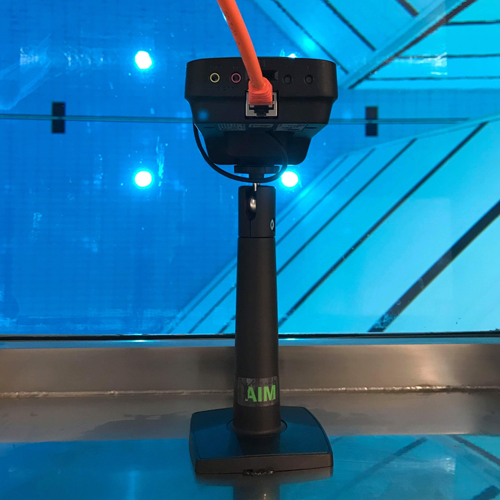
Measuring turn speed without wearables is possible with markerless video analysis. AIM Systems uses fixed cameras above and below the water, not sensors, to track a swimmer through the turn. No belt, no strap, no cable drag.
Why gear on the swimmer matters
A tethered speedometer adds resistance, even if it’s small. An IMU adds weight and can shift during a hard push-off. Neither is huge on its own, but over a full turn analysis session, these small changes add up. As a result, the numbers you get may not fully reflect a normal, unencumbered turn.
Camera-based tracking removes that variable entirely. The swimmer swims exactly as they would in a race, because there’s nothing on their body to account for.
What each approach actually measures
IMUs are good at capturing acceleration and rotation at a single point on the body. Tethered speedometers give you a continuous speed trace along the cable’s path. Both are proxies for what’s happening at the wall.
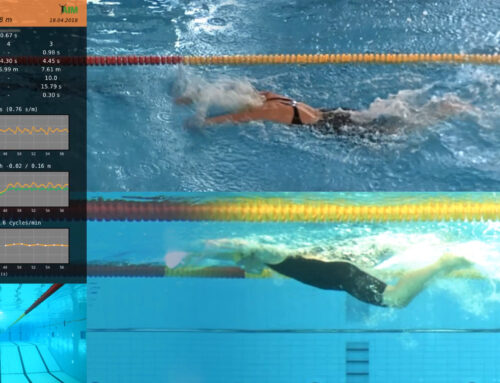
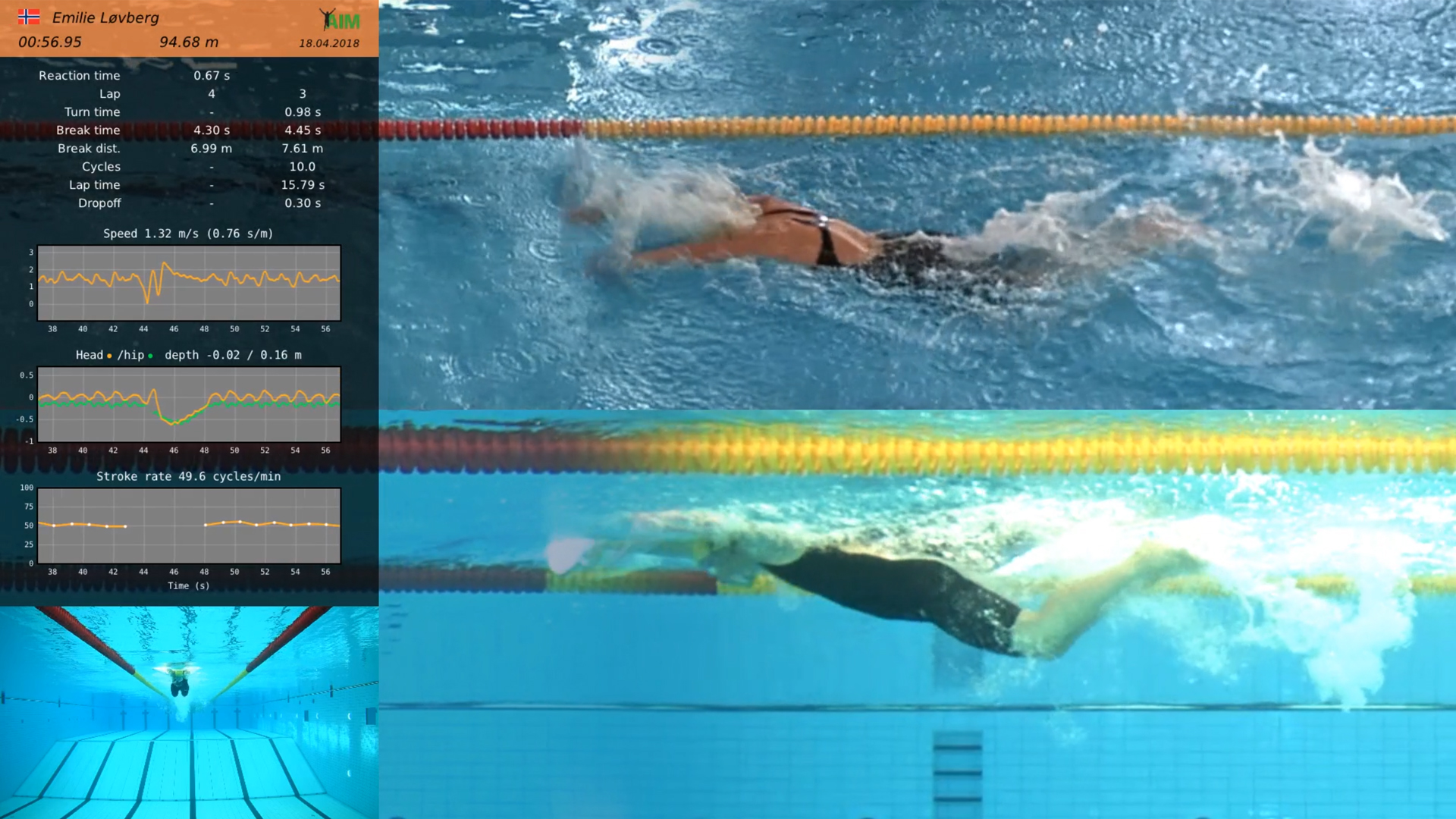
Video analysis, by contrast, sees the whole turn directly. AIM Systems captures turn time — from head-entry to push-off for freestyle and backstroke, or hand-touch to push-off for breaststroke and butterfly. It also captures breakout time, breakout distance, and underwater speed right after push-off. Because the system tracks the swimmer’s actual body position on camera, it can also plot head and hip depth continuously through the turn, something a single IMU point can’t fully represent.
Setup speed matters too
Strapping on a sensor between every rep slows down a practice. Camera-based capture doesn’t require touching the swimmer at all. That means more turns measured per session, with less disruption to the set.
Every automated capture also produces a stitched video with data overlaid, plus a spreadsheet of the underlying stats — so coaches can review both the footage and the numbers side by side. Turns can then be compared lap-by-lap against a swimmer’s own best times, another swimmer, or a manually entered reference time.
If you’re currently using stopwatch estimates or sensor-based tools and want to see what camera-only turn analysis looks like in practice, get in touch with AIM Systems. No pressure — just a look at what the data can show.
Frequently asked questions
Can turn speed be measured without attaching sensors to the swimmer?
Yes, markerless video systems like AIM Systems track turn time, breakout distance, and underwater speed using cameras alone, with no sensors on the swimmer.
Is camera-based turn analysis as accurate as IMUs or tethered speedometers?
Camera-based tracking measures the turn directly from footage, avoiding the added weight or drag that sensors and cables can introduce during the push-off.
Social Contact