
A fixed camera swim analysis system beats an upload-a-video app for one simple reason: it’s built for repeat use across an entire season, not a single race clip. University and national programs don’t need one good video. They need consistent, comparable data on every swimmer, every week, for years.
Most race analysis apps on the market today work the same way. A coach or parent films from the stands, uploads the clip, and gets some stroke metrics back. That’s fine for a one-off look at a meet swim. But it breaks down fast as a training tool, because the camera angle changes every time, the footage quality varies, and nothing is synced to official timing.
Why a fixed camera swim analysis system changes the data, not just the convenience
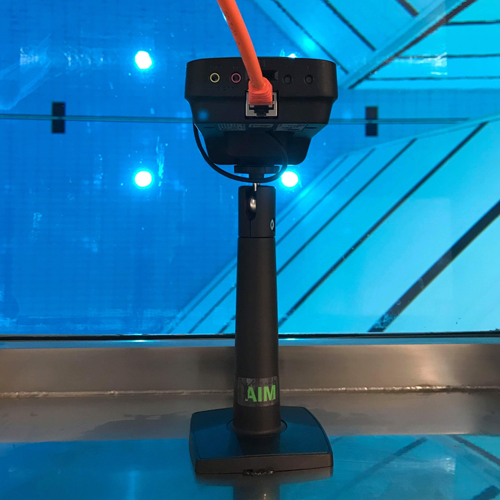
AIM Systems installs permanently at a facility — 11 cameras for a 25m pool, up to 22 for a 50m pool, covering above and below water along the full length. The cameras don’t move session to session. As a result, every swim is captured from the same angles, at the same resolution, under the same conditions.
That consistency matters more than it sounds. A stroke-count comparison between week 3 and week 12 is only meaningful if both swims were filmed the same way. Upload-a-video apps can’t promise that, because the camera is wherever someone happened to be standing.
AIM Systems also integrates directly with the Omega timing system already installed in the pool, pulling touchpad data for every lap. That means turn time, breakout distance, stroke rate, and lap time are all tied to official splits automatically — not estimated from a hand-held clip with no timing reference at all.
Built for training volume, not single races
A national team doesn’t analyze one race a month. It analyzes dozens of reps a week, across freestyle, backstroke, breaststroke, butterfly, medley, and underwater kick sets. AIM Systems is a fixed installation specifically because that’s what repeat, high-volume training analysis requires.
Each capture outputs a stitched video with data overlaid, plus a spreadsheet of the full lap-by-lap stats. A coach can then compare that swim against the swimmer’s own past best times, a teammate’s times, or a manually entered target — building a real longitudinal record instead of a folder of disconnected clips.
This also matters for how coaches should think about stroke mechanics. Research by Craig, Skehan, Pawelczyk, and Boomer (1985) on U.S. Olympic Trials swimmers found that in most events, speed improvements over time came from covering more distance per stroke, not stroking faster. But the study also found two exceptions — women’s 100m fly and 100m back — where speed gains came almost entirely from a faster stroke rate instead. That kind of event-specific pattern only becomes visible to a coaching staff if stroke rate and distance per stroke are tracked consistently, swim after swim, across a full season. A single uploaded clip can’t build that picture.
The same study found that as fatigue set in during longer races, faster swimmers held or raised their stroke rate to offset dropping distance per stroke, while slower swimmers let both fall. Watching dropoff trend across weeks of training — not just one race — is exactly the kind of pattern a fixed, always-on camera setup is built to surface.
Where this fits, and where it doesn’t
AIM Systems isn’t a meet-day tool. It’s a fixed installation, used at facilities like Kuortane Olympic Training Center, INCEP Paris, the Norwegian Institute of Sport, and SCAR in Lund. It doesn’t travel to competitions — it’s built for the training environment, where the real season-long work happens.
If your program is weighing a camera-only setup synced to Omega timing, it’s worth a conversation. Get in touch with AIM Systems to talk through what a fixed installation looks like for your facility.
Frequently asked questions
Is AIM Systems the same as upload-a-video race analysis apps?
No — AIM Systems is a fixed, permanently installed camera setup synced to Omega timing, while upload apps rely on single hand-held clips with no timing integration.
Can AIM Systems be used at swim meets or competitions?
No, it’s a fixed installation built for training facilities and does not travel to meets.
Does AIM Systems replace the pool’s existing timing system?
No, it integrates with the facility’s existing Omega timing system and uses its touchpad data for lap timing.
Sources
- Craig, A.B., Skehan, P.L., Pawelczyk, J.A., & Boomer, W.L. (1985). Velocity, stroke rate, and distance per stroke during elite swimming competition. Medicine and Science in Sports and Exercise, 17(6), 625-634. https://doi.org/10.1249/00005768-198512000-00001


Social Contact