
Underwater speed after the start is the fastest a swimmer will move in the entire race. It only goes down from there. That means the breakout decision — when to surface — is one of the highest-leverage choices a swimmer makes, and most coaches are guessing at it with a stopwatch instead of real data.

Research from Gonjo and Olstad (2020) studied sprint butterfly starts and turns and found something coaches should take seriously. Underwater speed after the start doesn’t hold steady and then drop. It decays continuously from the instant of push-off or entry until the swimmer surfaces. There’s no plateau to ride out.
Why underwater speed after the start never holds steady
This continuous decay means every extra moment underwater is slower than the moment before it. So staying down longer isn’t free. At some point, underwater speed drops below what the swimmer can sustain once they start stroking on the surface.
Surface too early, and you waste the fastest part of the race on a slower stroke phase. Surface too late, and you’re swimming an underwater phase that’s already decelerated past the point of usefulness. The breakout point is a trade-off, not a fixed rule — and it’s specific to each swimmer’s underwater speed curve.
The same study found that underwater kinematic variables had measurable relationships with overall start and turn segment times. In other words, what happens underwater isn’t a side note to the start — it’s a major, separately-coachable chunk of race time.
Coordination matters too, not just timing
Olstad et al. (2021) looked at breaststroke starts across 50m, 100m, and 200m races and found the arm-leg coordination pattern during the underwater pull-out stayed the same regardless of distance. What changed was glide duration — swimmers in longer races glided longer, adjusting the simple variable rather than reworking their limb timing. The study also found the dolphin kick consistently finished before the arm pull-out began, with roughly a 0.4-second gap being a workable target, though individual variability was high enough that this is worth coaching per-swimmer.
How to actually coach this
You can’t fix what you can’t see on a clock. A stopwatch tells you lap time, not the shape of the speed curve underwater. This is where frame-by-frame data changes the conversation with a swimmer.
- Measure underwater speed continuously from push-off to breakout, not just as one average number.
- Track breakout distance and timing against the swimmer’s own past races to see if they’re surfacing too early or riding the glide too long.
- Compare underwater speed decay across different race distances for the same swimmer.
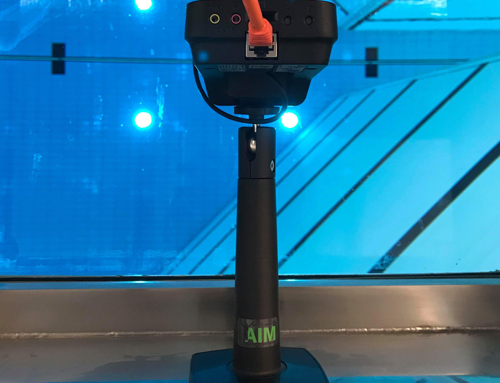
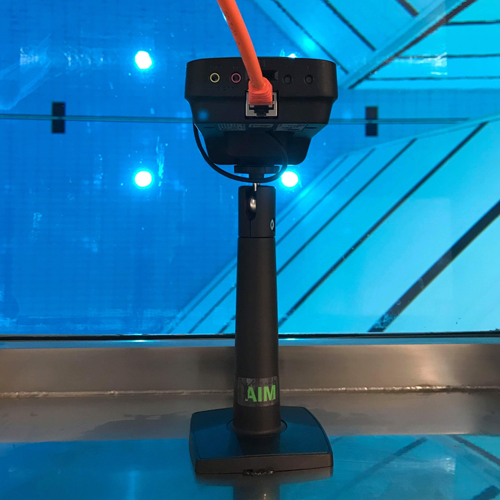
AIM Systems’ fixed camera installation captures exactly this. Continuous horizontal speed graphs run through the entire swim, with underwater speed after the start plotted from push-off to breakout and every stroke marked on the curve. That gives a coach the actual shape of the decay, not just a split time, and it compares cleanly against the swimmer’s personal-best underwater phase from a previous race.
Because the cameras track above and below the waterline without any sensor or marker on the swimmer, the breakout moment — the exact instant the head surfaces — gets flagged automatically alongside breakout distance. That’s the kind of detail that’s nearly impossible to call accurately by eye at full speed.
If you want to see what this looks like on your own swimmers, get in touch with AIM Systems — no pressure, just a look at the data.
Frequently asked questions
Does underwater speed stay constant after a swim start?
No, research on sprint butterfly starts found underwater speed decays continuously from push-off until the swimmer surfaces, with no plateau.
How do coaches know the best time to surface from a breakout?
The right breakout point is where underwater speed drops to match what the swimmer can sustain on the surface, which varies by swimmer and is best found by tracking the actual speed curve rather than guessing by feel.
Does arm-leg coordination change between 50m and 200m breaststroke starts?
No, a 2021 study found the coordination pattern stays the same across distances, while glide duration gets longer in longer races instead.
Sources
- Olstad, B.H., Gonjo, T., Conceição, A., Šťastný, J., & Seifert, L. (2021). Arm-leg coordination during the underwater pull-out sequence in the 50, 100 and 200 m breaststroke start. Journal of Science and Medicine in Sport. https://doi.org/10.1016/j.jsams.2021.08.006
- Gonjo, T., & Olstad, B.H. (2020). Start and Turn Performances of Competitive Swimmers in Sprint Butterfly Swimming. Journal of Sports Science and Medicine, 19(4), 727-734. https://www.jssm.org/mobile/abstmobile.php?id=jssm-19-727.xml

Social Contact