
Underwater kicking data tells a coach far more than how fast a swimmer’s feet are moving. It shows whether the swimmer’s core is holding a stable line through the water, or leaking energy through a wobbling hip and a sinking head. That’s the part most coaches can’t judge accurately by eye from the pool deck.
A weak core shows up as instability, not slowness. The hips drop. The head bobs. Horizontal speed drops even though the kick tempo looks fine. Watching from above the water, this is nearly impossible to catch consistently, because the breakdown happens below the surface, lap after lap.
Why underwater kicking data needs underwater cameras
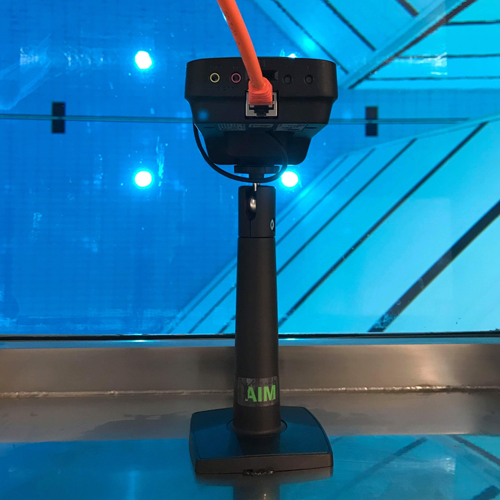
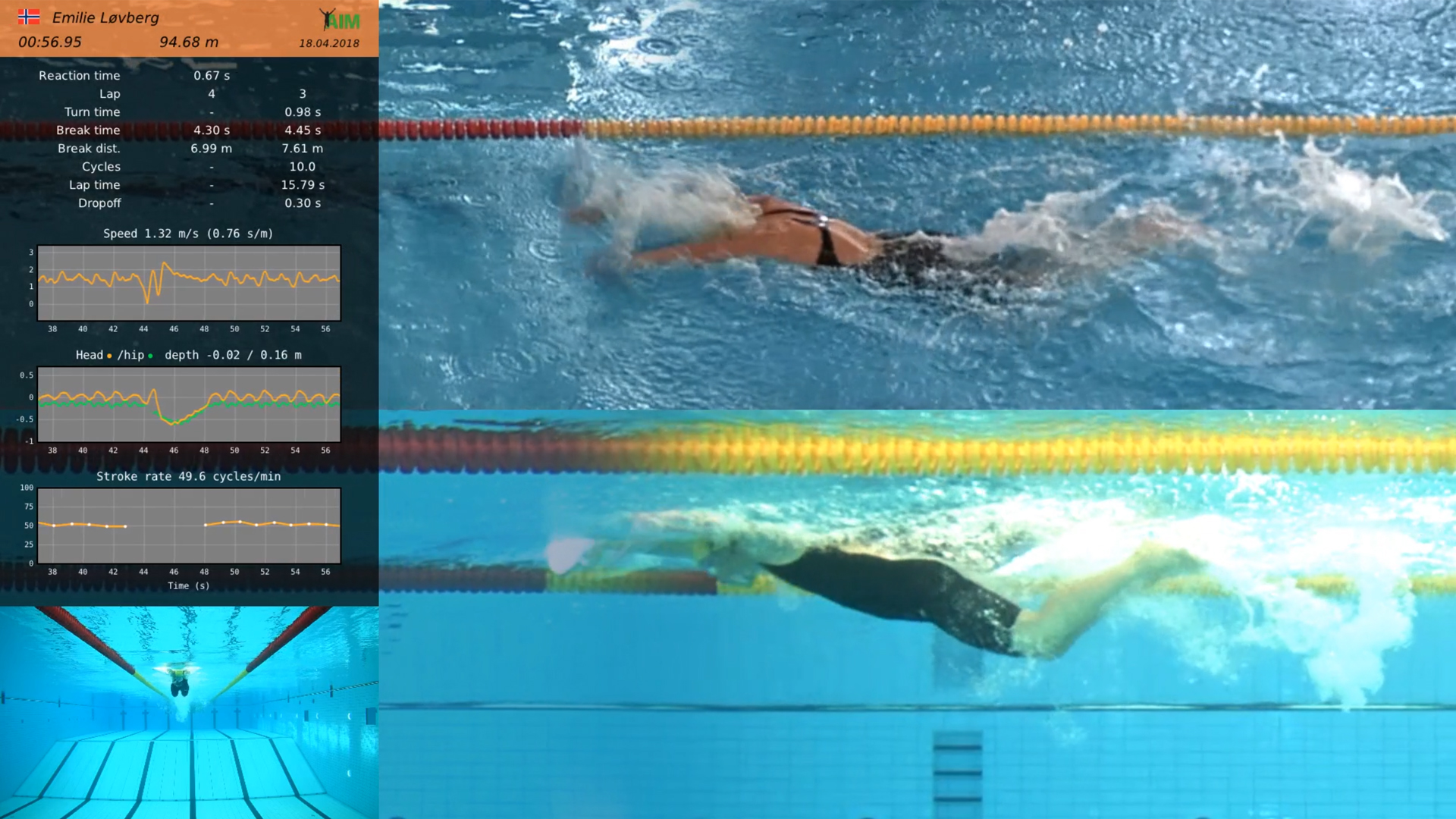
Head depth and hip depth are the two metrics that expose core control most directly. Both require underwater camera coverage to measure reliably — an above-water-only setup simply can’t see them. This is one reason AIM Systems tracks continuous head and hip depth graphs through the underwater phase, alongside horizontal speed and stroke rate, with each kick cycle marked on the graph.
When a swimmer’s core fatigues, the depth graph tells the story before the stopwatch does. Hip depth starts drifting instead of holding steady. Horizontal speed dips slightly even though the kick rate hasn’t changed. That combination — same tempo, less speed, more depth variation — is a clean signature of core breakdown, not a kicking problem.
Reading the data like a diagnostic, not a score
A single kicking set doesn’t tell you much on its own. The value comes from comparing one lap against another, or one week’s underwater set against last month’s. AIM Systems supports this directly: a swimmer’s underwater kicking data can be compared lap-by-lap against their own past best sets, against a training partner’s, or against a manually entered reference standard.
This turns underwater kicking work into an actual diagnostic tool instead of a guess. If hip depth holds steady for 12 meters and then breaks down, a coach knows exactly where core fatigue sets in — and can build dryland or short-set work around that exact distance.
Stroke rate research backs up why this kind of lap-by-lap detail matters. Craig and Pendergast’s foundational 1979 work established that swimming velocity is simply stroke rate multiplied by distance per stroke — meaning speed always comes from a trade-off, never one fixed number to chase. The same logic applies underwater: kick rate alone means nothing without knowing what it’s actually producing in speed and body position.
What to do with the data
- Watch for hip depth drift as the first sign of core fatigue, before speed drops noticeably.
- Compare the same swimmer’s underwater sets over weeks, not just within one session.
- Treat a steady head/hip line as the real technique target — not just kick tempo.
Because AIM Systems runs on a fixed camera installation with no wearables or markers needed, this data comes from the same underwater kicking sets a coach already runs — nothing changes about the workout itself. The system just sees what the eye can’t hold onto for an entire length.
If you want to see what this looks like with your own swimmers, get in touch with AIM Systems — no pressure, just a look at the data.
Frequently asked questions
Can underwater kicking data show core strength directly?
Not directly as a strength number, but head and hip depth stability during kicking sets reveal core control, since a weak core causes the hips and head to drift or sink.
Why does measuring hip depth require underwater cameras?
Hip depth and head depth can only be measured reliably with underwater camera coverage, since an above-water-only view can’t see body position beneath the surface.
How is underwater kicking data best used by coaches?
It’s most useful compared lap-by-lap against a swimmer’s own past sets or a training partner’s data, which turns it into a diagnostic for exactly where fatigue breaks down technique.
Sources
- Craig, A.B., & Pendergast, D.R. (1979). Relationships of stroke rate, distance per stroke, and velocity in competitive swimming. Medicine and Science in Sports, 11(3), 278-283. https://doi.org/10.1249/00005768-197901130-00011
- Craig, A.B., Skehan, P.L., Pawelczyk, J.A., & Boomer, W.L. (1985). Velocity, stroke rate, and distance per stroke during elite swimming competition. Medicine and Science in Sports and Exercise, 17(6), 625-634. https://doi.org/10.1249/00005768-198512000-00001
Social Contact