
Most backstroke starts get coached the same way: drive off the wall hard, kick fast, get to the surface. That focus on leg power misses the bigger picture. What separates a good backstroke start from a great one is underwater speed off the wall, not just how hard the legs are kicking.
Underwater speed after the start is a specific, measurable phase: how fast the swimmer moves from the moment they leave the wall until they break the surface. Leg power feeds into that speed, but so does body position, streamline, and timing of the kick. A swimmer with strong legs but a poor streamline will still lose speed to drag before they ever reach breakout.
Why underwater speed matters more than leg power alone
Research from Gonjo and Olstad (2021) reviewed race analysis studies and found that breakout distance has grown substantially since the 1980s. Backstroke breakout distance specifically is up roughly 50-66% compared to older benchmarks. Swimmers today are staying underwater longer and moving faster while they do it, because coaching has shifted toward optimizing the whole underwater phase, not just kick strength.
That same review found something coaches should take seriously: fixed-distance measurements, like “the first 15 meters,” consistently under- or over-estimate a swimmer’s true underwater performance. Every swimmer breaks out at a different point. Measuring from a generic mark instead of the swimmer’s actual breakout point gives a distorted picture of how fast they really moved underwater.
What this means for training
Instead of just timing the kick or counting kick cycles, coaches should look at underwater speed as its own number. Two swimmers can have identical kick counts off the wall and still post very different underwater speeds, because one holds a tighter streamline or times their first kick better relative to their glide.
- Track underwater speed from push-off to each swimmer’s own breakout point, not a fixed distance.
- Watch for where speed peaks and where it drops off before breakout.
- Compare a swimmer’s underwater speed across sessions, not just their kick count.
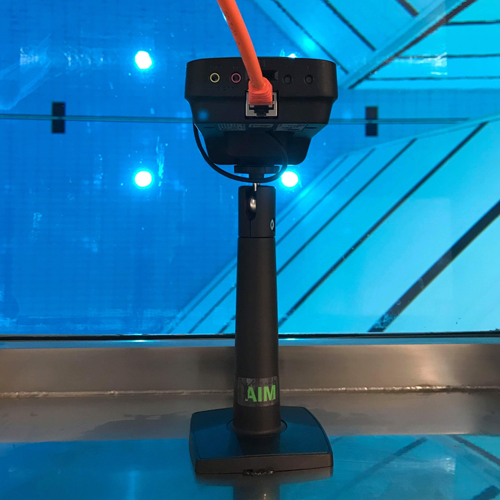
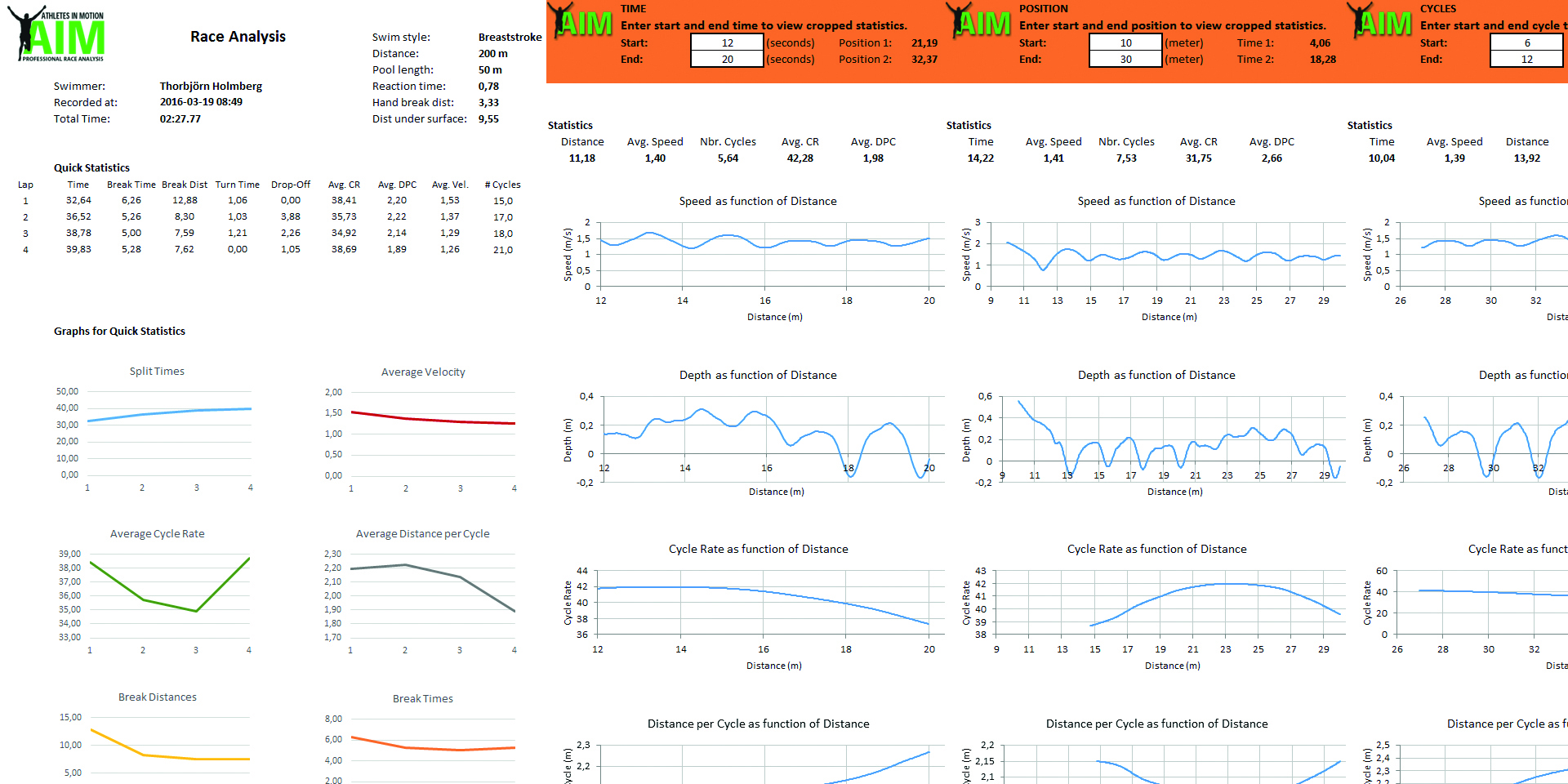
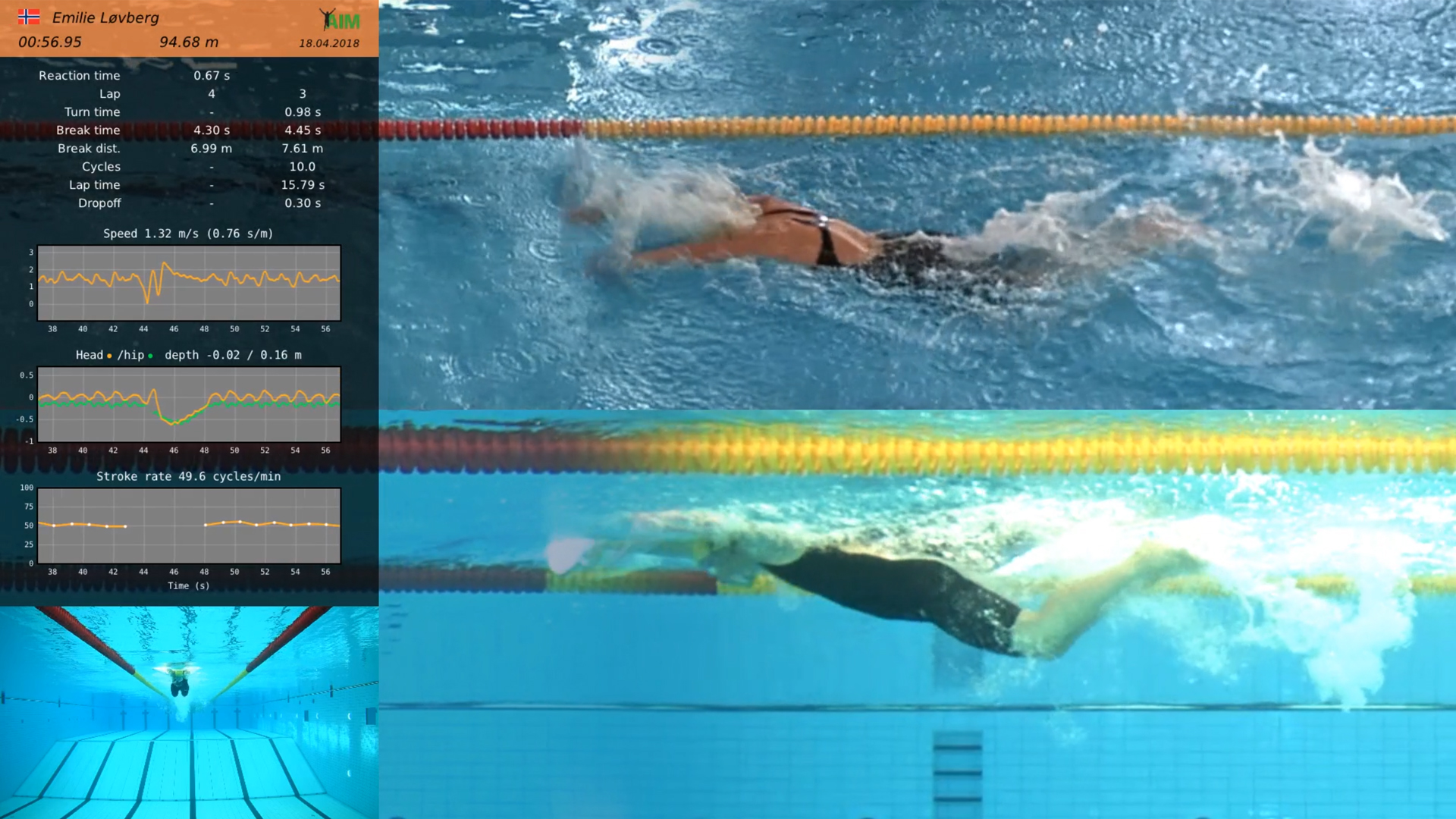
This is exactly where AIM Systems’ automated capture helps. The system measures underwater speed after the start automatically, along with entry/landing distance and breakout time and distance, for whichever stroke and distance the coach selects. Because the analysis is tied to each swimmer’s actual breakout point rather than a fixed distance, coaches get the same kind of individualized measurement the research points to, without hand-timing it off a stopwatch.
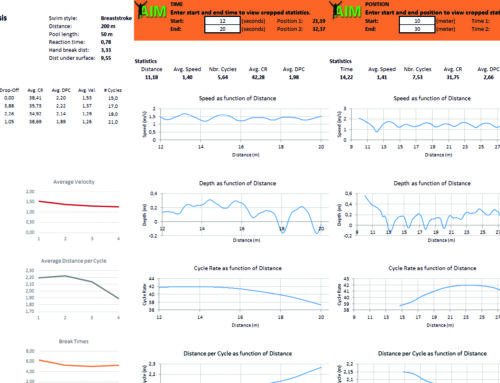
The system also plots horizontal speed continuously through the underwater phase, so a coach can see exactly where speed builds or fades before the head breaks the surface. That’s a much sharper diagnostic than watching the swim by eye and guessing whether the kick “looked strong.”
Because AIM Systems is a markerless, camera-only setup, there’s no wearable sensor or gear needed to get this data. Coaches can pull up the same underwater-speed numbers from a taper-week backstroke start and compare them directly against the swimmer’s best previous start, using the system’s own comparison tracking.
If your team trains at a facility with AIM Systems installed, or you’re curious whether it fits your program, get in touch through our contact page. We’re happy to walk through what the data actually looks like for a backstroke start.
Frequently asked questions
What is underwater speed in a backstroke start?
It’s how fast the swimmer travels from push-off until they break the surface, measured independently of kick count or leg power.
Why shouldn’t coaches use a fixed distance like 15 meters to measure breakout?
Research review by Gonjo and Olstad (2021) found fixed-distance measurements consistently under- or over-estimate a swimmer’s true underwater performance compared to measuring from their actual individual breakout point.
Can AIM Systems measure underwater speed automatically?
Yes, AIM Systems’ automated capture measures underwater speed after the start along with breakout time and distance for the selected stroke and distance.
Sources
- Veiga, S., Cala, A., Frutos, P.G., & Navarro, E. (2014). Comparison of starts and turns of national and regional level swimmers by individualized-distance measurements. Sports Biomechanics, 13(3), 285-295. https://doi.org/10.1080/14763141.2014.910265
- Gonjo, T., & Olstad, B.H. (2021). Race Analysis in Competitive Swimming: A Narrative Review. International Journal of Environmental Research and Public Health, 18(1), 69. https://doi.org/10.3390/ijerph18010069
Social Contact