
Most tools track a swimmer’s best times. Almost none track how those times were built. If you coach at a national training center, tracking swimmer technical progression across months matters more than any single race result.
A personal-best tracker tells you a swimmer went faster. It doesn’t tell you why. Was the turn faster? Did the breakout improve? Did stroke rate change, or did dropoff between laps shrink? Those answers require session-to-session technical data, not a season summary.
Why a Home Training Center Changes What’s Possible
National team swimmers train at the same pool, week after week, for months. That’s the exact condition a fixed, camera-only system needs to build a real technical history.
AIM Systems is installed permanently at facilities like Kuortane Olympic Training Center and the Norwegian Institute of Sport. Because the cameras never move and calibration happens once at install, every session produces comparable data, automatically, without a coach re-measuring anything by hand.
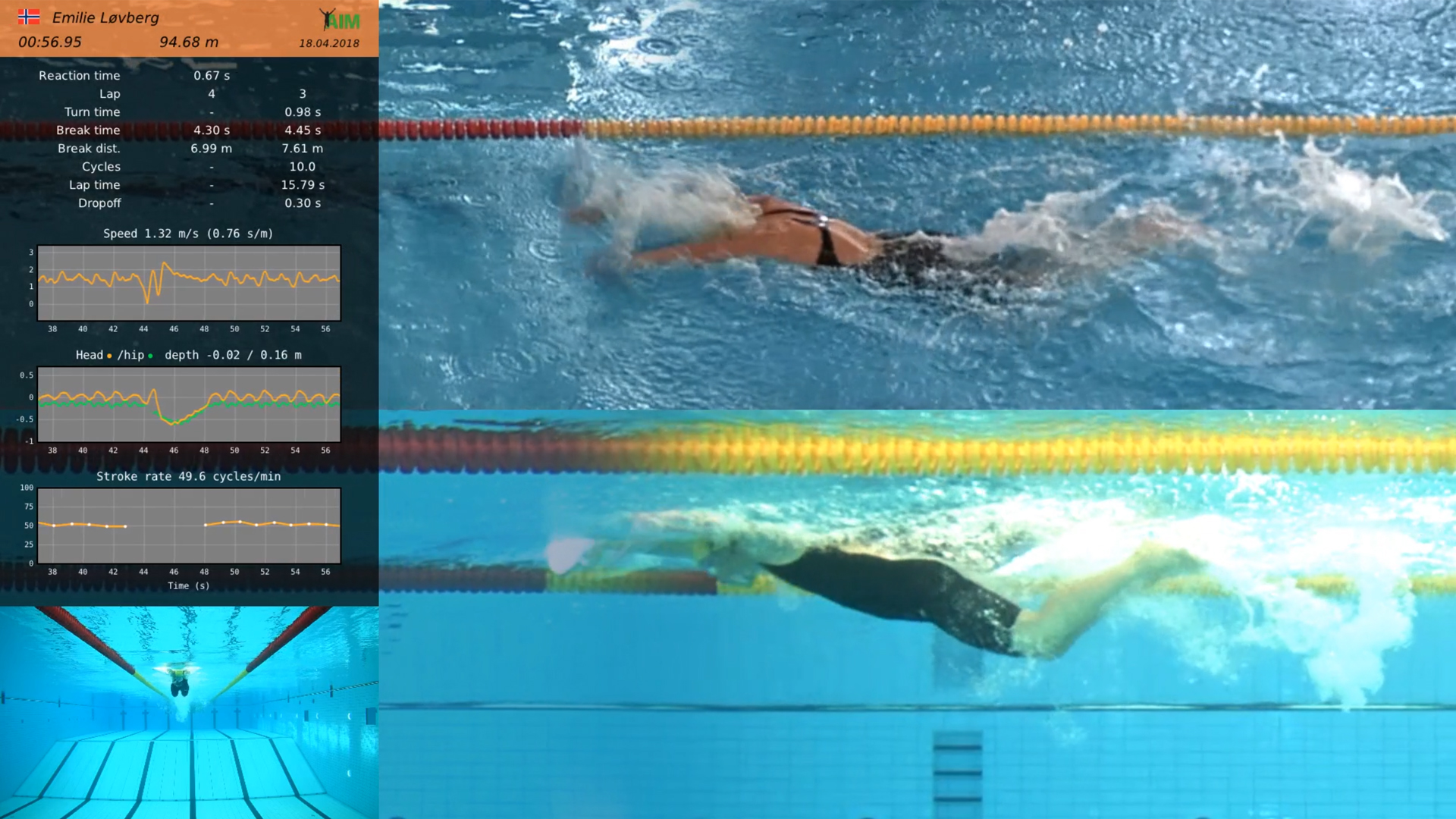
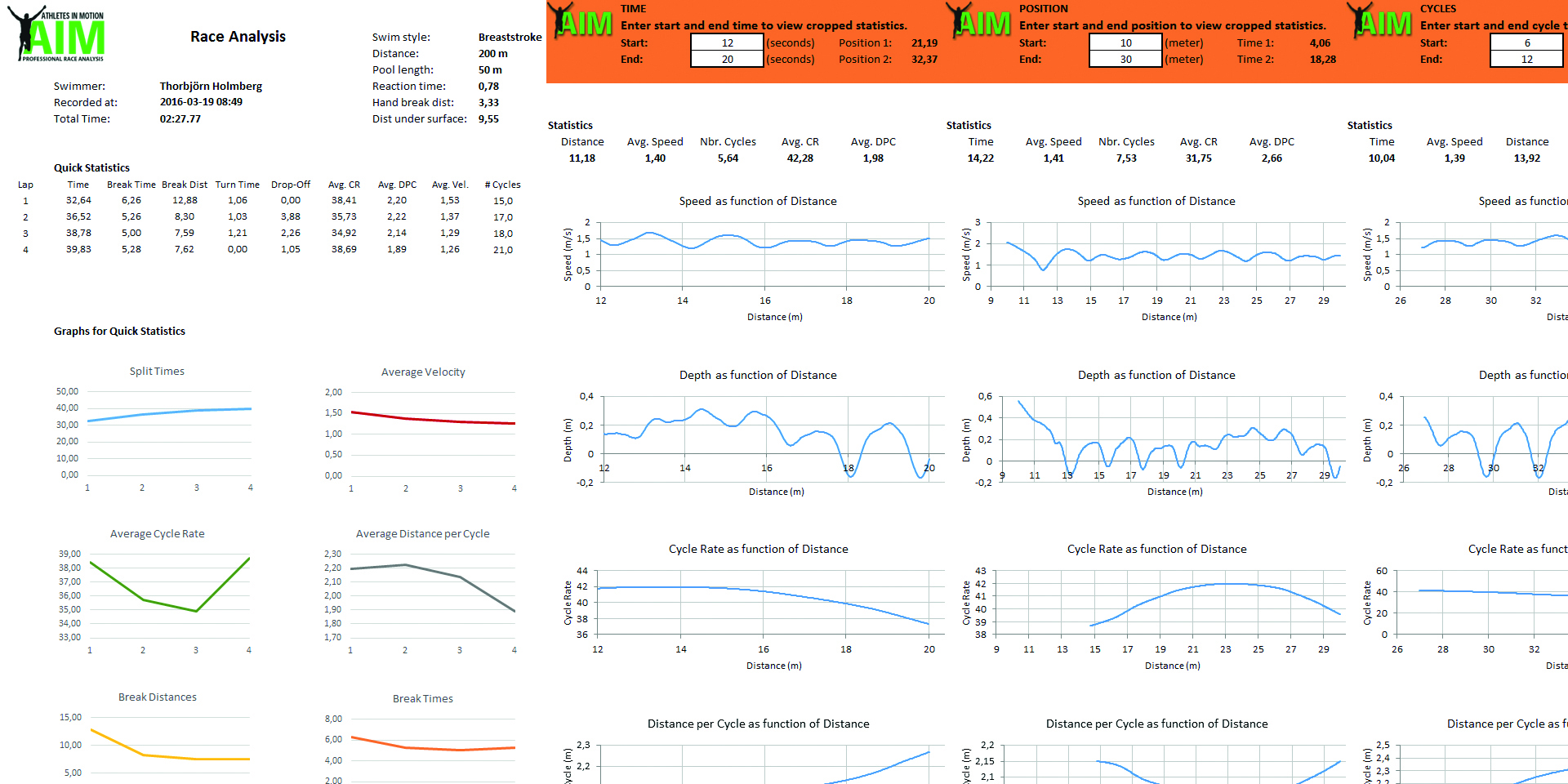
Each swim produces a stitched video with overlaid data and a spreadsheet of stats: turn time, breakout time and distance, stroke count, stroke rate, lap time, and dropoff versus the previous lap. Stacked across a season, these numbers become a technical timeline, not just a results log.
What the Data Actually Reveals
Turn time matters more than most coaches assume. Research from the Norwegian School of Sport Sciences (Olstad et al., 2020) found that in short-course 100m breaststroke, turns made up roughly 44% of total finishing time — more than clean swimming itself. The same study found turn-out time got progressively slower across a race, by about 0.38 seconds from first turn to last, driven by a weaker push-off and shorter breakout, not a slower pivot.
That’s a specific, coachable signal. If a swimmer’s breakout distance shrinks lap by lap over a season, that’s measurable evidence of fading push-off power, not just fatigue in general.
Stroke rate tells a different story. A study by Simbaña-Escobar, Hellard, and Seifert (2018), analyzing 2015 World and French Championship finalists in 50m and 100m freestyle, found stroke rate drops not just lap to lap but within a single lap. The researchers found no single pacing pattern shared by fast swimmers — each athlete adapts stroke rate and stroke length to their own race demands.
That means comparing one swimmer’s stroke rate against a teammate’s is less useful than comparing that swimmer against their own history. AIM Systems supports exactly this: comparing a swim lap-by-lap against the same swimmer’s past top times, a teammate’s times, or a manually entered reference.
Building the Timeline
- Log turn time and breakout distance every timed set, not just at meets.
- Watch dropoff trends across a full season, not single sessions.
- Compare stroke rate against the swimmer’s own past swims, not a generic standard.
Over a season, this turns into a body of evidence a coach can actually act on — where a stopwatch and occasional video review leave gaps.
If you’re working at a training center and want to see how this looks with your own swimmers, get in touch with AIM Systems.
Sources
- Olstad, B.H., Wathne, H., & Gonjo, T. (2020). Key Factors Related to Short Course 100 m Breaststroke Performance. International Journal of Environmental Research and Public Health, 17(17), 6257. https://doi.org/10.3390/ijerph17176257
- Simbaña-Escobar, D., Hellard, P., & Seifert, L. (2018). Modelling stroking parameters in competitive sprint swimming: Understanding inter- and intra-lap variability to assess pacing management. Human Movement Science, 61, 219-230. https://doi.org/10.1016/j.humov.2018.08.002
Coaching Perspectives Referenced
- Bill Boomer — “Posture, Line and Balance” (also called the “inside/out” approach) — coaching body alignment, core stability, and balance in the water as the foundation that stroke mechanics are built on top of, rather than teaching arm/leg mechanics in isolation. (Craig, Skehan, Pawelczyk & Boomer (1985) — see research-library.json, Championship Winning Swimming: Stroke Series (Championship Productions))
Social Contact