
A university coach with eight swimmers to review after a time trial doesn’t have three hours to spare. Yet that’s roughly what manual video review takes when a coach captures footage on a phone or a single camera, then scrubs through it frame by frame to log turn times, breakouts, and stroke counts by hand.
Tools like SwimWatch and Dartfish have improved how that footage gets tagged and shared. But the capture and review process is still manual. A coach or assistant has to film the swim, sync it, and mark the segments themselves. That’s the gap automated race analysis is built to close.
What Automated Race Analysis Actually Removes From the Workflow
AIM Systems uses a fixed multi-camera installation — up to 22 cameras in a 50m pool — mounted above and below the water along the pool’s length. It integrates with the Omega timing system already in place, using touchpad data for timing accuracy.
Because the cameras are fixed and calibrated once at installation, there’s no rigging, no aiming, no manual syncing before every session. Pool setup takes about 2 minutes. The system tracks one swimmer in one lane through the swim, and once the race finishes, the software automatically stitches the camera angles together and extracts the data.
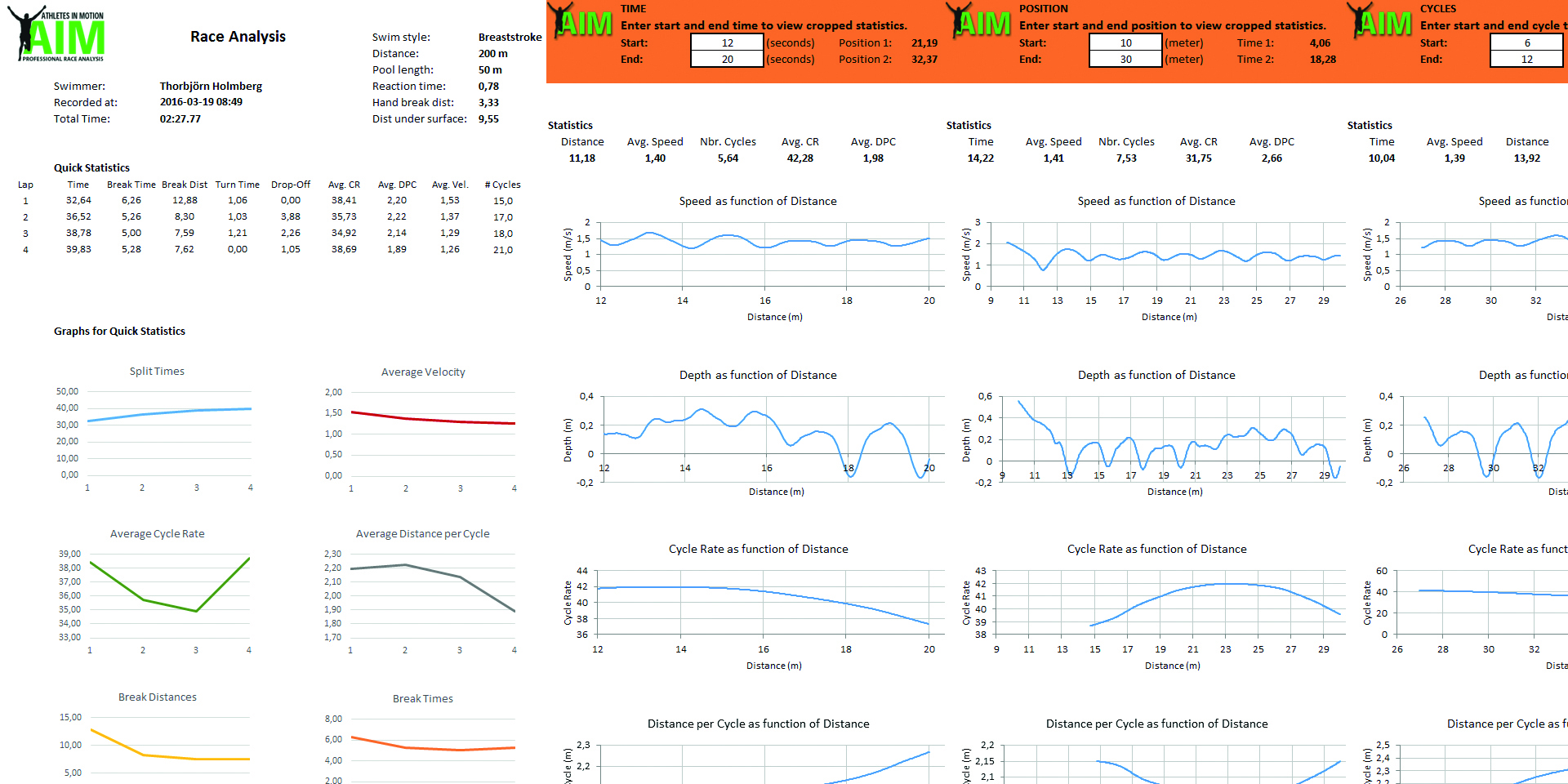
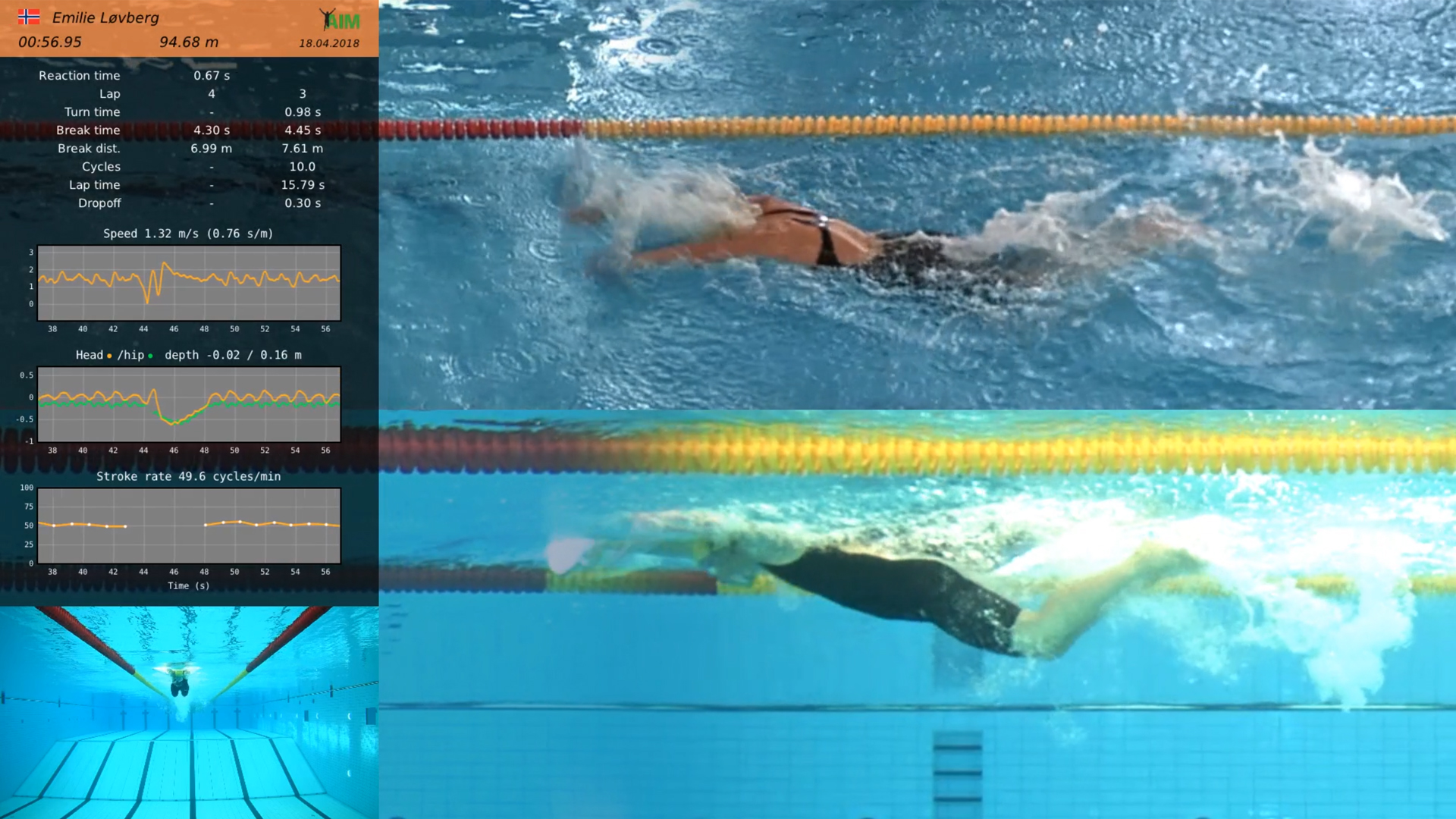
That process takes about 2 minutes for a 50m race and about 4 minutes for a 100m race. The output is a stitched video with data overlaid, plus a spreadsheet — turn time, breakout time and distance, stroke count, stroke rate, lap time, and dropoff from the previous lap. No coach sits with a stopwatch and a legal pad reconstructing it after the fact.
Why Manual Segment Timing Is Riskier Than It Looks
Manual review isn’t just slow. It’s also inconsistent in ways coaches don’t always notice. A narrative review by Gonjo and Olstad (2021) looked at 22 studies on race analysis and found no consistent definition of the turn segment across the literature — researchers have defined it seven different ways. If trained researchers can’t agree on where a turn segment starts and ends, a coach eyeballing video between meets is working with even softer numbers.
The same review found that fixed-distance markers, like measuring “the first 15m” after every start, consistently misjudge a swimmer’s actual underwater distance and speed. Every swimmer breaks out at a different point. Measuring from a fixed line instead of the swimmer’s real breakout point either overstates or understates their underwater speed. AIM Systems measures breakout at the swimmer’s actual surfacing point, every time, because the underwater cameras capture head position directly instead of relying on a fixed distance line.
Where This Matters Most for a University Program
University coaches usually manage large rosters across multiple strokes with limited staff. Automated capture means a coach isn’t the bottleneck between a swim and the feedback that swim generates. A swimmer can see their turn time and dropoff within minutes of getting out of the water, not the next day’s practice.
It also means comparison data is reliable over a season. A swimmer’s 100m breaststroke turn time from October can be compared lap-by-lap against their time in March, using the same measurement method both times — not a different camera angle or a different assistant’s manual mark.
Getting Started
AIM Systems is already running at Kuortane Olympic Training Center, INCEP Paris, the Norwegian Institute of Sport, and SCAR in Lund. If your program is weighing whether automated capture is worth the shift from manual video review, it’s worth a conversation.
Reach out through our contact page to talk through what a fixed installation would look like at your facility.
Frequently asked questions
How is automated race analysis different from manual video review?
Automated race analysis uses fixed, pre-calibrated cameras to capture and extract turn time, breakout distance, and stroke data automatically, while manual review requires a coach to film, sync, and log each segment by hand.
How long does automated race analysis take after a swim?
Complete video and data analysis is ready in about 2 minutes for a 50m race and about 4 minutes for a 100m race.
Why is breakout distance hard to measure accurately by eye or with fixed markers?
Research on race analysis has found that fixed-distance markers like ‘the first 15m’ consistently misjudge a swimmer’s true underwater distance because each swimmer breaks out at a different point.
Sources
- Gonjo, T., & Olstad, B.H. (2021). Race Analysis in Competitive Swimming: A Narrative Review. International Journal of Environmental Research and Public Health, 18(1), 69. https://doi.org/10.3390/ijerph18010069
- Craig, A.B., & Pendergast, D.R. (1979). Relationships of stroke rate, distance per stroke, and velocity in competitive swimming. Medicine and Science in Sports, 11(3), 278-283. https://doi.org/10.1249/00005768-197901130-00011
Social Contact