
A swimmer finishes a rep. The coach has maybe two minutes before the next one starts. What can actually happen in that window with real race data — not just a stopwatch time?
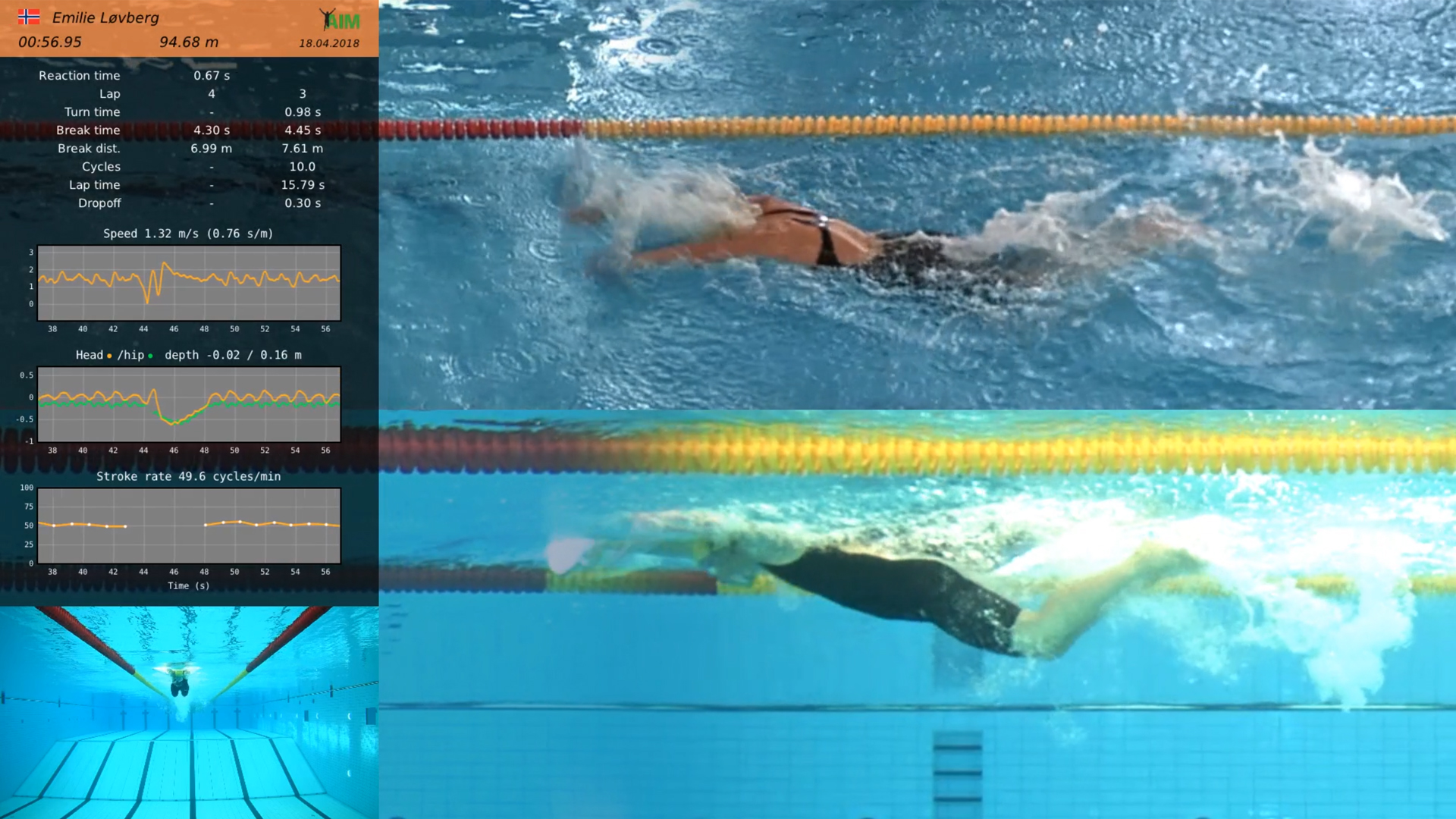
With AIM Systems, the answer is concrete. For a 50m rep, the full stitched video and data spreadsheet are ready in about 2 minutes. For 100m, about 4 minutes. That means the numbers are often ready before the swimmer is done shaking out their arms on the wall.
What you can pull up between reps
The system gives you lap time, stroke count, stroke rate, turn time, and breakout distance for that swim. You can also see dropoff — how much the lap time changed compared to the previous lap. That’s the number that tells you if fatigue is creeping in early.
Instead of telling a swimmer “your turn felt slow,” you can show them the actual turn time and breakout distance from the wall they just left. That’s a real coaching cue, not a guess.
Comparing to something real
Raw numbers mean little without context. AIM Systems lets you stack this swim against the swimmer’s own best times, a teammate’s times, or a reference time you enter manually. If breakout distance is short compared to their personal best, that’s your correction for the next rep — not next week’s practice.
This matters because breakout distance has shifted a lot over time. Research reviewed by Gonjo and Olstad (2021) found that breakout distances after starts and turns have grown substantially since the 1980s — backstroke alone is up roughly 50 to 66%. Old mental benchmarks a coach might be carrying around are probably outdated.
Stroke rate isn’t a target by itself
If stroke rate looks high, don’t assume the swimmer is working harder. Craig and Pendergast’s classic 1979 research showed velocity is just stroke rate multiplied by distance per stroke. There’s no single correct rate — it’s a trade-off.
So between reps, look at stroke rate next to stroke count and lap time together. A swimmer can hit the same speed with a shorter, quicker stroke or a longer, slower one. The data tells you which one they’re actually doing right now, not which one they should theoretically use.
Why this changes the conversation
None of this requires the swimmer to wear a sensor or a special cap. AIM Systems tracks everything with fixed cameras, so the feedback loop stays fast and the swimmer stays focused on swimming, not on gear.
The bigger shift isn’t the speed of the software. It’s that feedback can happen inside the set, while the last rep is still fresh in the swimmer’s body.
Curious how this would work at your pool? Get in touch with AIM Systems and we’ll walk through it.
Frequently asked questions
How fast can a coach get race data during a swim practice?
AIM Systems delivers the full stitched video and data spreadsheet in about 2 minutes for a 50m swim and about 4 minutes for a 100m swim.
What metrics can a coach check between reps?
Lap time, stroke count, stroke rate, turn time, breakout distance, and dropoff from the previous lap are all available right after the swim.
Sources
- Gonjo, T., & Olstad, B.H. (2021). Race Analysis in Competitive Swimming: A Narrative Review. International Journal of Environmental Research and Public Health, 18(1), 69. https://doi.org/10.3390/ijerph18010069
- Craig, A.B., & Pendergast, D.R. (1979). Relationships of stroke rate, distance per stroke, and velocity in competitive swimming. Medicine and Science in Sports, 11(3), 278-283. https://doi.org/10.1249/00005768-197901130-00011
Social Contact