
Coaches ask a simple question after every race: where did we lose time? Swim race analysis research has been trying to answer that for decades, and the honest answer is messier than most coaches expect.
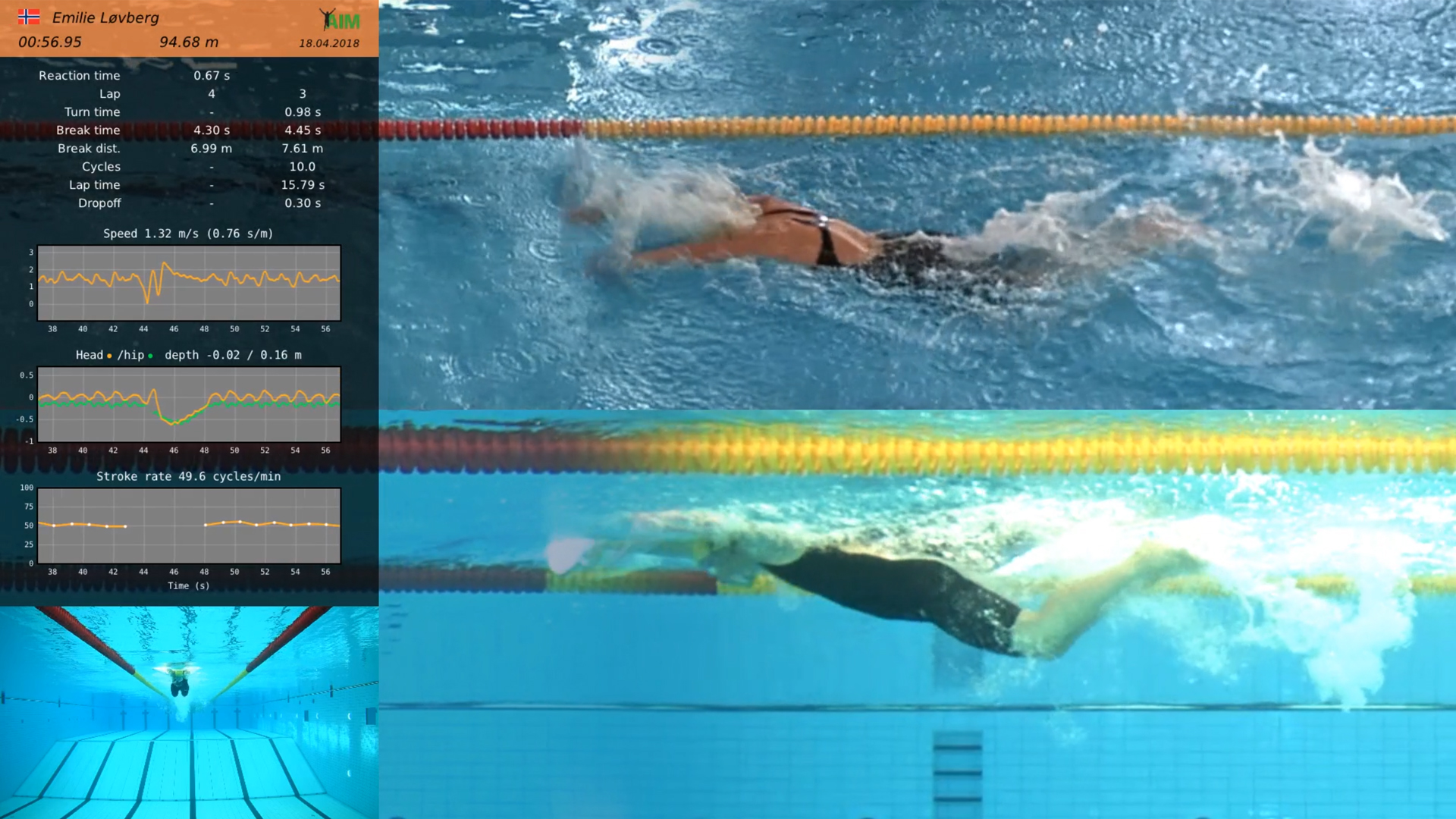
A 2021 narrative review by Gonjo and Olstad, published in the International Journal of Environmental Research and Public Health, looked at 22 studies on competitive swimming race analysis. One finding stands out: there’s no consistent definition of a race segment across the literature. The turn alone has been defined seven different ways. That means two studies claiming different “turn times” might not be measuring the same thing at all.
Why fixed distances mislead swim race analysis
Here’s the part that matters most for coaches on deck. Many studies measure the underwater phase using a fixed distance, like “the first 15 meters.” But swimmers don’t all breakout at the same point.
The review found that fixed-distance segments consistently under- or over-estimate a swimmer’s true underwater distance and speed. A swimmer who breaks out at 12 meters gets measured differently than one who breaks out at 16 meters, even if both are labeled with the same “first 15m” split. The only accurate way to measure underwater speed is from the swimmer’s actual breakout point, not an arbitrary line on the pool floor.
This is exactly why AIM Systems measures breakout time and breakout distance individually for each swimmer, every lap, rather than applying a fixed split. The camera system detects the actual moment the head surfaces, so the underwater speed calculated afterward reflects what really happened, not an approximation.
Old benchmarks don’t hold up anymore
The same review found that breakout distances have grown substantially since the 1980s, across all four strokes. Backstroke breakout distance specifically is up roughly 50 to 66 percent compared to older data. A coach still comparing swimmers against benchmarks from that era is working from numbers that no longer reflect how the sport is swum.
The review also flagged a gap worth knowing about: most published race-analysis research focuses on freestyle, on 100m and 200m distances, and on international-level swimmers. There’s very little published data on 50m races, individual medley, relay starts, or short-course racing. If you coach sprinters or medley swimmers, published norms may simply not exist for your event.
What this means on your pool deck
The research points to one practical conclusion: generic benchmarks are risky, and your own swimmer’s history is the more reliable comparison point.
Instead of asking whether a swimmer beat a published average, ask whether they beat their own last breakout distance, their own turn time, their own stroke count. That’s the comparison that actually holds up, because it’s measured the same way every time.
- Measure breakout from the actual surfacing point, not a fixed distance marker.
- Track a swimmer against their own past times rather than dated external benchmarks.
- Be cautious with published “average” turn or breakout numbers — definitions vary study to study.
AIM Systems’ automated capture measures turn time, breakout distance, stroke count, and underwater speed the same way every session, then lets you compare a swim lap-by-lap against that same swimmer’s own past top times. That consistency is what published research keeps circling back to as the missing piece.
If you want to see how this works with your own swimmers, get in touch — no pressure, just a conversation about what you’re trying to measure.
Frequently asked questions
Why don’t fixed-distance splits like ‘first 15 meters’ accurately measure underwater speed?
Because swimmers breakout at different points, so a fixed distance mixes underwater and surface swimming differently for each swimmer.
Has breakout distance changed over time in competitive swimming?
Yes, published research shows breakout distances have grown substantially since the 1980s, with backstroke up roughly 50 to 66 percent.
Is there good published research on 50m races and short-course swimming?
No, most race-analysis research focuses on freestyle, 100m and 200m events, and international-level swimmers, leaving 50m and short-course events under-studied.
Sources
- Gonjo, T., & Olstad, B.H. (2021). Race Analysis in Competitive Swimming: A Narrative Review. International Journal of Environmental Research and Public Health, 18(1), 69. https://doi.org/10.3390/ijerph18010069
Social Contact