
A swimmer’s reaction time off the block almost never looks the same in a meet as it does in practice. That’s not an excuse — it’s a pattern coaches see constantly, and it’s worth understanding instead of ignoring.
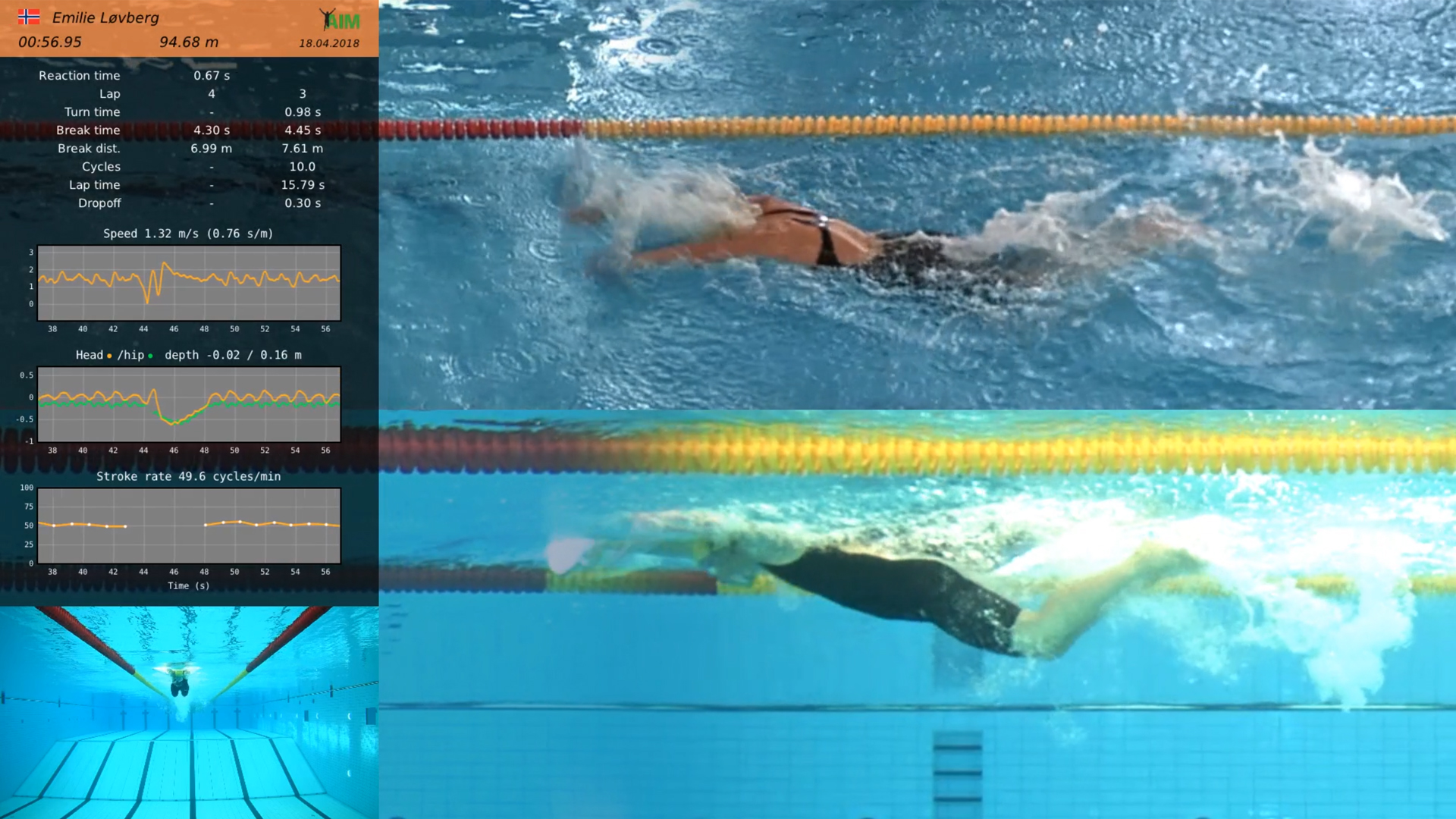
In practice, a swimmer starts in a calm environment. There’s no crowd, no scoreboard, no rival in lane four. Reaction time in that setting tends to be steady, because the nervous system isn’t under real pressure.
Competition changes the input. Adrenaline speeds some swimmers up — they anticipate the start signal and shave tenths off their practice numbers. Others tense up, hesitate slightly, and react slower than they do at home. Both patterns are normal. The problem is that most coaches never actually measure the gap between the two.
Why swim reaction time is hard to track consistently
Stopwatch estimates from the pool deck can’t capture reaction time with any precision. It happens in a fraction of a second, off a starting block, often from an angle that hides the swimmer’s actual movement.
This is part of a bigger issue in race analysis generally. A review of race-analysis research by Gonjo and Olstad (2021) found that studies don’t even agree on how to define race segments — the turn phase alone has been defined seven different ways across the literature. If something as visible as a turn is inconsistently measured, reaction time off the block is even easier to get wrong by eye.
That’s exactly the kind of measurement problem a fixed camera system solves. AIM Systems captures block time and reaction time automatically, from the same camera angle, every single session. That consistency is what lets a coach compare a Tuesday practice start to a Saturday meet start and trust the numbers actually mean something.
What to actually do with the data
Once you have real numbers from both settings, look for the direction of the shift, not just the size of it. A swimmer who reacts faster under pressure is trusting their preparation. A swimmer who slows down may be second-guessing the signal or overthinking the start.
From there, the fix is different for each swimmer. The one who’s slowing down under pressure often needs more starts practiced in a race-like setting — with a horn, a false-start relay, or simulated crowd noise. The one who’s jumping the gun early needs work on patience off the block, since a fast reaction with a false start costs more than a slightly slower, legal one.
AIM Systems also lets you compare a swimmer’s start against their own past times or against a teammate’s, lap by lap. That makes it easy to see whether a reaction-time change under pressure is a one-off or a real trend across multiple meets.
- Track reaction time and block time separately in practice and in meets.
- Look at the direction of change, not just the raw number.
- Build race-like pressure into some practice starts, deliberately.
- Compare across multiple meets before changing anything in training.
None of this requires guesswork. It requires consistent measurement, taken the same way every time, so you can trust what you’re comparing.
If you want to see how this works at your own facility, get in touch with AIM Systems — no pressure, just a conversation about what you’re trying to measure.
Frequently asked questions
Does reaction time usually get faster or slower under competition pressure?
It varies by swimmer — some react faster due to adrenaline, while others slow down from added tension, which is why individual tracking matters more than assumptions.
Can you measure reaction time accurately without special sensors?
Yes, AIM Systems captures block time and reaction time using fixed cameras only, with no wearable sensors or markers needed on the swimmer.
Why is comparing race-analysis numbers across studies difficult?
A 2021 review by Gonjo and Olstad found no consistent definition of race segments across the research, with the turn phase alone defined seven different ways.
Sources
- Gonjo, T., & Olstad, B.H. (2021). Race Analysis in Competitive Swimming: A Narrative Review. International Journal of Environmental Research and Public Health, 18(1), 69. https://doi.org/10.3390/ijerph18010069
Social Contact