
A coach with a pole camera can capture a swimmer’s stroke. What that coach can’t do is turn that footage into precise, repeatable numbers without hours of manual review. That’s the core limit of handheld video, and it’s why more national and university programs are moving to automated swim analysis.
Manual video review has been the standard for decades. A staff member films from the deck, scrubs through footage frame by frame, and estimates turn times or stroke counts by eye. It works, but it’s slow, inconsistent between reviewers, and impossible to scale across a full training group.
What Manual Video Review Actually Misses
Tools like handheld cameras or pole-mounted rigs give you an angle, not a system. They capture video. They don’t measure anything on their own. A coach still has to watch, pause, and guess at split-second events like breakout timing or push-off delay.
That guesswork adds up. Turn time differences that matter — 0.2 or 0.3 seconds — are hard to see reliably by eye, frame by frame, especially underwater. And because there’s no timing integration, none of it lines up automatically with official lap splits.
What Automated Swim Analysis Changes
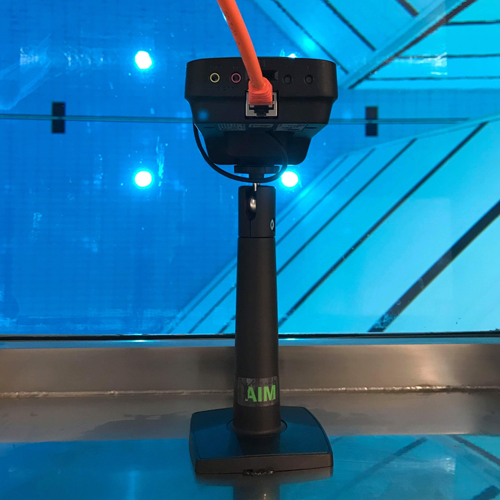
AIM Systems takes a different approach. Instead of one handheld camera, a fixed installation uses up to 22 cameras — 11 for a 25m pool, up to 22 for a 50m pool — mounted above and below the waterline along the full length of the course.
Because the system integrates directly with the pool’s existing Omega timing system, every measurement syncs to real touchpad splits. There’s no manual stopwatch, no separate stream to reconcile by hand.
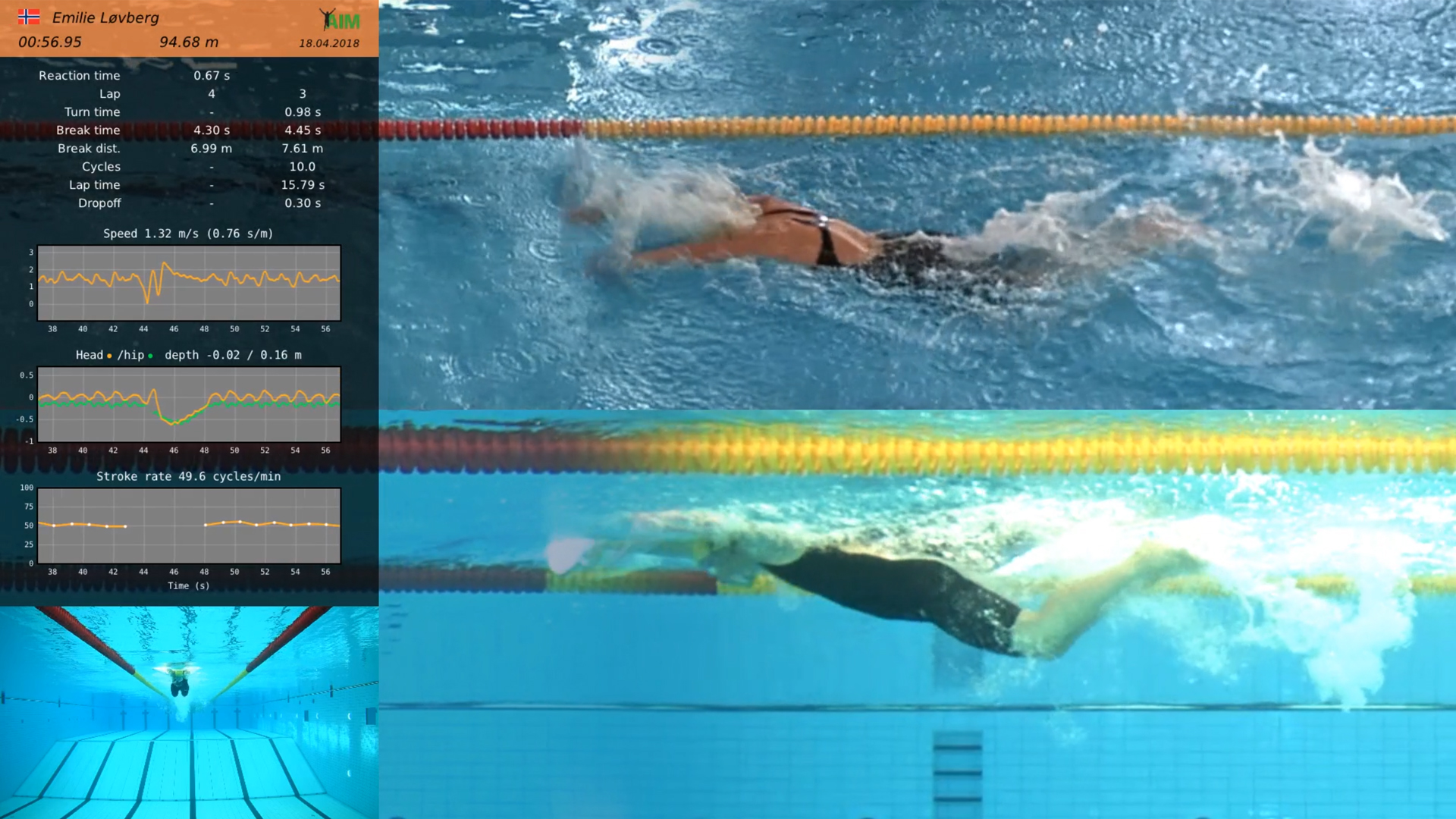
For a chosen stroke and distance, the system automatically produces a stitched video with data overlaid, plus a full spreadsheet of stats. Per lap, it captures:
- Turn time, from head-entry or hand-touch through push-off
- Breakout time and distance after the underwater phase
- Stroke count and stroke rate
- Lap time and dropoff versus the previous lap
- Underwater speed and entry distance off the start
None of that requires anyone to pause a video and count frames. It’s captured automatically, every time, the same way.
Why This Matters for High-Performance Programs
Because AIM Systems is markerless — no cap color, no sensors, no wearables — it reads stroke mechanics and underwater technique directly from camera footage. That precision on the underwater phase is something a single pole camera simply cannot replicate at the same resolution.
It also means a coaching staff can compare a swimmer’s lap-by-lap data against their own past best times, another swimmer’s swim, or a manually entered reference time. That’s a very different workflow than re-watching two video files side by side and guessing where the gap is.
This is why programs at places like Kuortane Olympic Training Center, INCEP Paris, and the Swedish Center for Aquatic Research in Lund have moved past handheld and single-camera setups. At that level, the question isn’t whether you have video. It’s whether your video comes with numbers attached.
If your program is still relying on manual review to catch turn and breakout issues, it’s worth seeing what automated, timing-synced capture looks like in practice. Get in touch with AIM Systems to talk through what a fixed installation would look like at your facility.
Frequently asked questions
How is automated swim analysis different from a GoPro or pole camera?
A GoPro or pole camera only records footage, while automated swim analysis uses fixed multi-camera installations to automatically calculate turn time, breakout distance, stroke rate, and other metrics without manual review.
Does AIM Systems’ automated analysis sync with existing pool timing systems?
Yes, AIM Systems integrates directly with a standard Omega timing system already installed in the pool, using touchpad data for timing.
Can automated swim analysis track a swimmer’s underwater technique?
Yes, AIM Systems uses above- and below-water cameras to measure breakout distance, underwater speed, and stroke mechanics without requiring any wearable markers or special caps.
Social Contact