
Breakout timing gets most of the attention when coaches talk about underwater work. But breakout distance tells a different story, one that’s easy to miss with a stopwatch and a good eye alone.
Breakout distance is how far a swimmer travels before their head breaks the surface after a start or turn. Two swimmers can surface at the exact same time and still be a full body length apart. That gap is often the difference between a good underwater phase and a wasted one.
Why breakout distance matters more than breakout time alone
Time tells you when a swimmer came up. Distance tells you whether they used the underwater phase well before they did. A swimmer who breaks out late but close to the wall may just be gliding instead of kicking. A swimmer who breaks out at the same time but three meters further down the pool is likely still moving faster underwater than they would be on the surface.
This matters because underwater speed, for most trained swimmers, is faster than surface swimming speed. As a result, staying underwater longer isn’t automatically bad, and surfacing early isn’t automatically good. The question is whether the extra distance underwater is still contributing speed, or if the swimmer has decelerated into what’s effectively a slow glide before they surface.
Where this shows up in practice
Take a breaststroke pullout. Two swimmers might both surface at 1.4 seconds off the wall. One has traveled 3.5 meters underwater; the other has covered 4.2 meters. The second swimmer is getting more out of every turn, lap after lap, without spending extra energy on it.
Over a 200m race, that gap compounds. Multiply it across six or seven turns and it can be the entire margin between two closely matched swimmers.
Why this is hard to measure by hand
Estimating breakout distance from poolside is rough work. Coaches usually eyeball it against lane markers, which gives a rough estimate at best. It also can’t be tracked consistently across every lap of every practice.
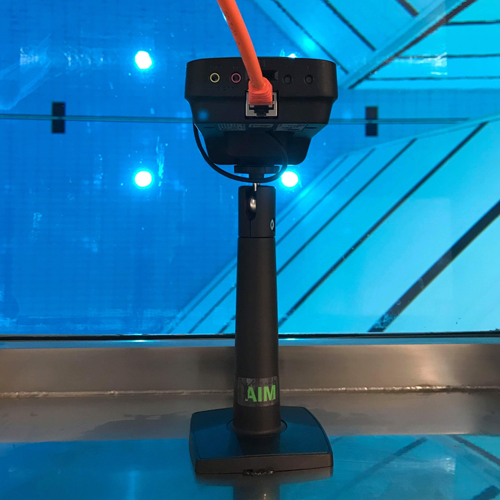
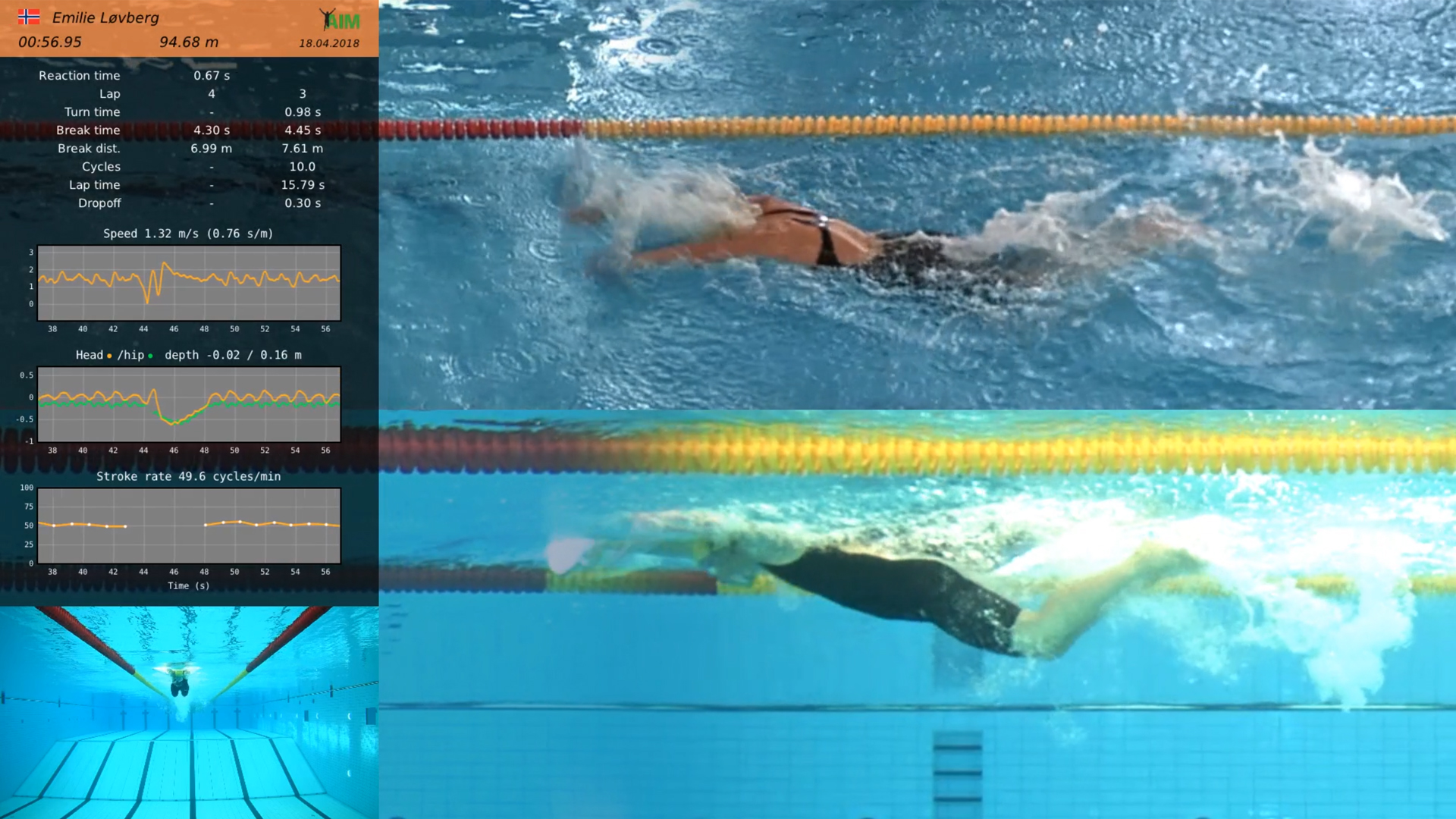
This is where AIM Systems’ underwater camera coverage changes what’s possible. Because the system tracks the swimmer with cameras both above and below the water — no wearable sensors or markers needed — it captures breakout time and breakout distance automatically, on every lap, for freestyle, backstroke, breaststroke, and butterfly. The output includes a stitched video with the data overlaid, plus a spreadsheet of the underlying numbers, so a coach can see exactly where the head surfaced relative to the wall.
That precision matters most when you’re trying to compare a swimmer’s breakout distance across a full season, or against a training partner. Because AIM Systems logs it consistently, coaches can compare current swims against a swimmer’s own past times or a manually entered reference, lap by lap, without guessing.
What to do with the number
Once you have breakout distance on record, use it alongside underwater speed and stroke count off the wall. If breakout distance is increasing but underwater speed is dropping, the swimmer is drifting, not swimming. If both are increasing together, the underwater phase is genuinely getting stronger.
Track it every session, not just at meets. Small changes in breakout distance often show up in training weeks before they show up in race results.
If you want to see how this looks with your own swimmers, get in touch with AIM Systems. It’s a quick conversation, no pressure.
Frequently asked questions
What is breakout distance in swimming?
Breakout distance is how far a swimmer travels underwater, from the wall, before their head surfaces after a start or turn.
Is a longer breakout distance always better?
No, a longer breakout distance is only beneficial if the swimmer is still moving faster underwater than they would on the surface.
How does AIM Systems measure breakout distance?
AIM Systems uses above- and below-water cameras to automatically track breakout time and distance on every lap without any wearable sensors.
Social Contact