
Breakout distance is the point where a swimmer’s head surfaces after a start or turn. It’s one of the most coachable numbers in swimming. But too many coaches try to fix it by drilling kick count instead — and that’s a mistake.
Adding more kicks doesn’t automatically extend breakout distance. It can even shorten it, if the extra kicks come with slower underwater speed or poor timing off the wall. The goal isn’t a kick count target. It’s where the head actually surfaces, and how fast the swimmer got there.
Why chasing kick count backfires
Coaches often tell a swimmer to “take two more kicks” underwater, hoping it’ll push breakout distance out further. In practice, this can slow the swimmer down. If those extra kicks are weak or mistimed, the swimmer loses horizontal speed before they even reach the surface.
Research from Veiga, Roig, and Gómez-Ruano (2016) looked at underwater phases at World Championship level. In 100m races, how far swimmers traveled underwater had little connection to finishing time in most strokes — except butterfly. What mattered more was underwater speed, not underwater distance. In 200m races, the pattern reversed: distance became the stronger predictor. That’s a real distinction. A 100m underwater strategy and a 200m underwater strategy are not the same skill at different intensities. They’re different skills entirely.
This means coaching breakout distance in isolation, without knowing the race distance a swimmer is training for, is coaching blind.
Coach the outcome, not the kick count
Instead of prescribing a fixed number of kicks, coach to the measured breakout point and the speed leading into it. If a swimmer’s breakout distance is short but their underwater speed is strong, the fix might be timing the transition to swimming strokes better — not adding kicks.
If breakout distance is long but underwater speed drops off in the final meter, that’s a different problem. The swimmer is drifting, not swimming. Coaching each case the same way, with “kick more,” misses what’s actually happening.
This is also where fixed-distance benchmarks get coaches into trouble. Gonjo and Olstad’s 2021 review of race-analysis literature found that using a fixed marker, like the first 15 meters, consistently under- or overestimates a swimmer’s true underwater performance compared with measuring from their actual individual breakout point. A swimmer who breaks out at 12 meters and one who breaks out at 16 meters are not doing the same thing at the 15m mark — treating them as equivalent hides the real signal.
How AIM Systems makes this measurable
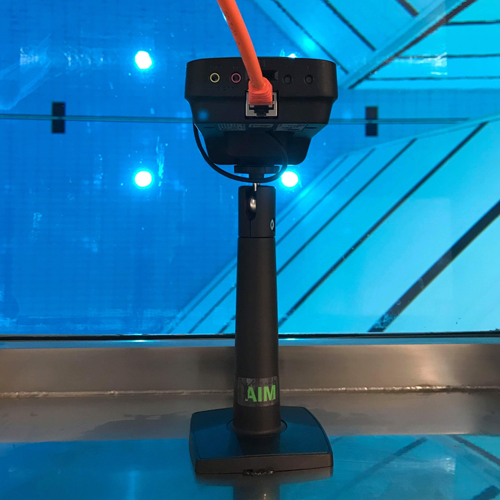
AIM Systems captures breakout distance and underwater speed automatically after every start and turn, from fixed cameras with no wearables or markers needed on the swimmer. Because the underwater cameras track the whole submerged phase, you get the actual breakout point for that specific swim — not an estimate from a fixed line on the pool deck.
The stitched video and data spreadsheet let you see breakout distance next to underwater speed, lap by lap, and compare it against the swimmer’s own past times. That’s the difference between coaching by feel and coaching from what actually happened in the water.
It’s also worth remembering that breakout distances have grown substantially since the 1980s across all four strokes. Backstroke alone is up roughly 50-66%. Old mental benchmarks from when you swam competitively may simply be outdated.
If you want to see how this looks on your own swimmers, get in touch with AIM Systems at https://aimsystems.se/contact/.
Frequently asked questions
Does adding more underwater kicks increase breakout distance?
Not necessarily — extra kicks only help if they maintain underwater speed, otherwise they can shorten effective breakout distance.
Is underwater distance or underwater speed more important for race time?
It depends on race distance: speed matters more in 100m races while distance matters more in 200m races, according to World Championship-level research.
How does AIM Systems measure breakout distance?
AIM Systems uses fixed underwater and above-water cameras to detect the exact point a swimmer’s head surfaces, without any wearable markers.
Sources
- Gonjo, T., & Olstad, B.H. (2021). Race Analysis in Competitive Swimming: A Narrative Review. International Journal of Environmental Research and Public Health, 18(1), 69. https://doi.org/10.3390/ijerph18010069
- Veiga, S., Roig, A., & Gómez-Ruano, M.A. (2016). Do faster swimmers spend longer underwater than slower swimmers at World Championships? European Journal of Sport Science, 16(8), 919-926. https://doi.org/10.1080/17461391.2016.1153727


Social Contact