
A swimmer finishes a 100m breaststroke set on Tuesday. The coach reviews video the following Monday. By then, the swimmer has trained five more sessions and has no memory of what their body actually did on that particular pull-out. This is the swim feedback gap, and it’s costing more than most coaches realize.
The gap matters because technique correction depends on the swimmer connecting a cue to a specific sensation. When a week passes, that connection is gone. The coach can still point out a slow turn or a weak breakout, but the swimmer is now correcting a memory, not a feeling.
Why same-session feedback changes what gets fixed
Same-session review lets a swimmer feel a stroke, then immediately see the data behind it. That’s a very different learning loop than watching footage days later out of context. The sooner the feedback arrives, the more precisely a swimmer can link a change in stroke count or turn time to what they did differently in the water.
This isn’t just about speed of delivery. It’s about which details actually get coached. Research from the Norwegian School of Sport Sciences (Gonjo & Olstad, 2021) analyzed elite versus sub-elite breaststrokers using time-series velocity data. The surprising finding: elite swimmers weren’t faster because of a quicker pull-out. Both groups were equally strong, or equally weak, in that phase.
Instead, elite swimmers won laps through clean-swimming velocity, 7-11% faster per lap, and glide velocity off the wall, about 13% faster in laps two and three. The study also modeled swapping a swimmer’s best pull-out segments into their weaker laps. Two swimmers with nearly identical race times could both have gone under 60 seconds. That’s a huge amount of performance sitting in a phase most programs barely review, let alone review same-day.
What this means for a review workflow
If the pull-out and transition are this under-coached, a week-later review makes it worse. The swimmer won’t remember the subtle timing of their transition from four sessions ago. Same-session review is the only way to catch it while the swimmer can still describe what they felt.
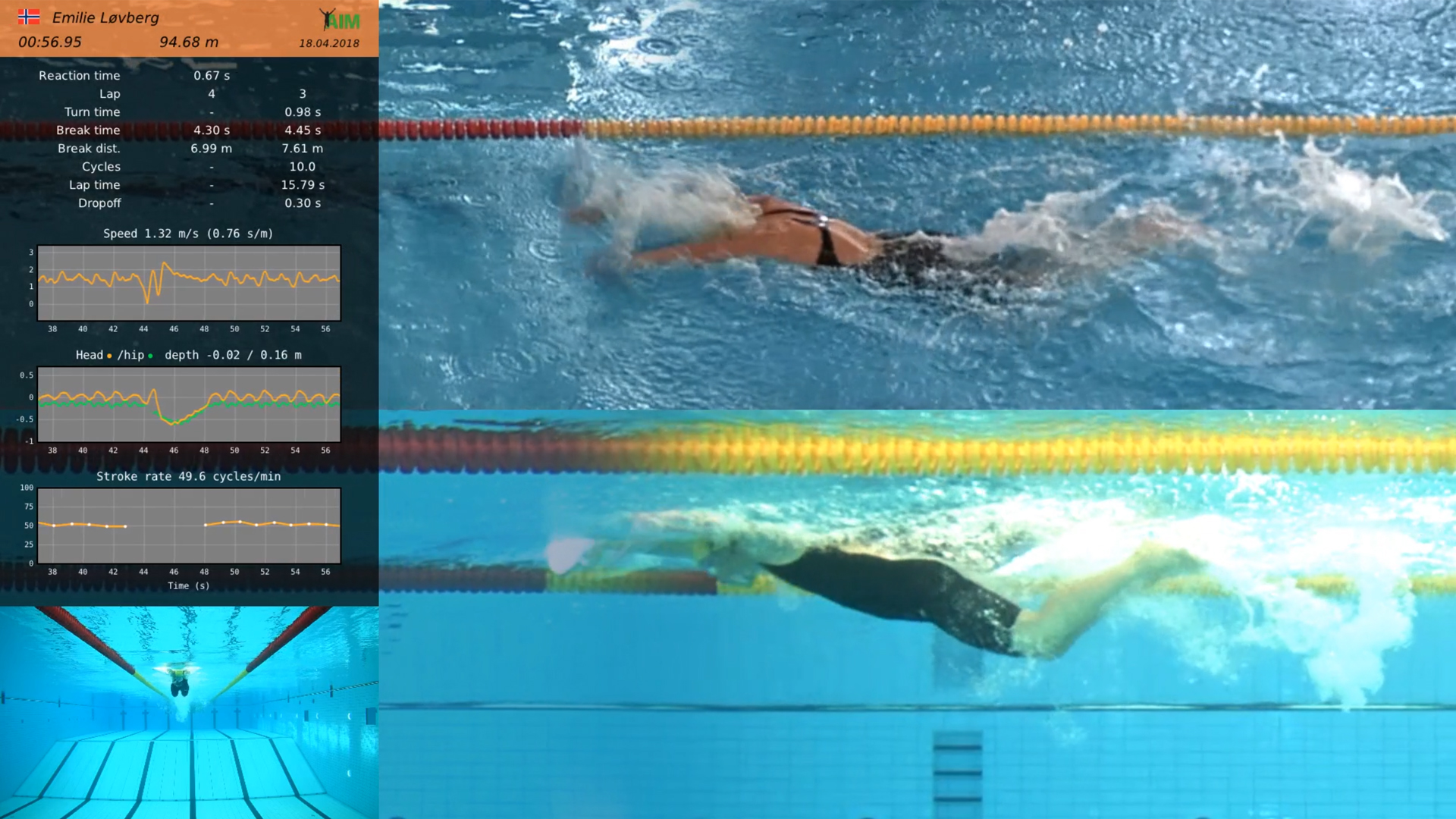
This is precisely the gap AIM Systems is built to close. Pool setup takes about two minutes. During the swim, the fixed camera installation captures the swimmer throughout the lap or the full race. After the swim, the software automatically stitches and analyzes the footage, with the complete video and data ready in about two minutes for a 50m race or about four minutes for a 100m race.
That means a coach can pull up turn time, breakout distance, stroke rate, and lap-by-lap dropoff before the swimmer’s next rep. The conversation happens while the water is still wet, not the following Monday. It also means a swimmer’s transition phase, the exact area the breaststroke research flagged as under-coached, gets reviewed with the same urgency as the visible parts of the stroke.
- Same-session feedback links a cue to a felt sensation, not a memory.
- Delayed review tends to skip subtle phases like the pull-out and transition.
- Fast automated analysis lets coaches address those phases before the next rep.
If you’re curious how this would work in your own facility, get in touch with AIM Systems at aimsystems.se/contact and we’ll walk through it.
Frequently asked questions
Why does same-session feedback work better than reviewing swim video later?
A swimmer can only connect a coaching cue to a specific stroke sensation while it’s still fresh, and that link fades within days.
How fast can a coach get race data after a swim with AIM Systems?
Complete stitched video and data analysis is ready in about 2 minutes for a 50m race and about 4 minutes for a 100m race.
Is the pull-out phase actually important in breaststroke performance?
Research using the AIM race analysis system found the pull-out itself didn’t separate elite from sub-elite swimmers, but swapping in a swimmer’s best pull-out segments could bring two similar racers under 60 seconds, showing it’s a high-value but under-coached phase.
Sources
- Gonjo, T., & Olstad, B.H. (2021). Differences between elite and sub-elite swimmers in a 100 m breaststroke: a new race analysis approach with time-series velocity data. Sports Biomechanics. https://doi.org/10.1080/14763141.2021.1954238
Social Contact