
Individual medley turn times tell a coach something a final split never can. They show exactly where a swimmer loses time — not just “somewhere in the middle 100,” but on the specific wall where one stroke hands off to the next.
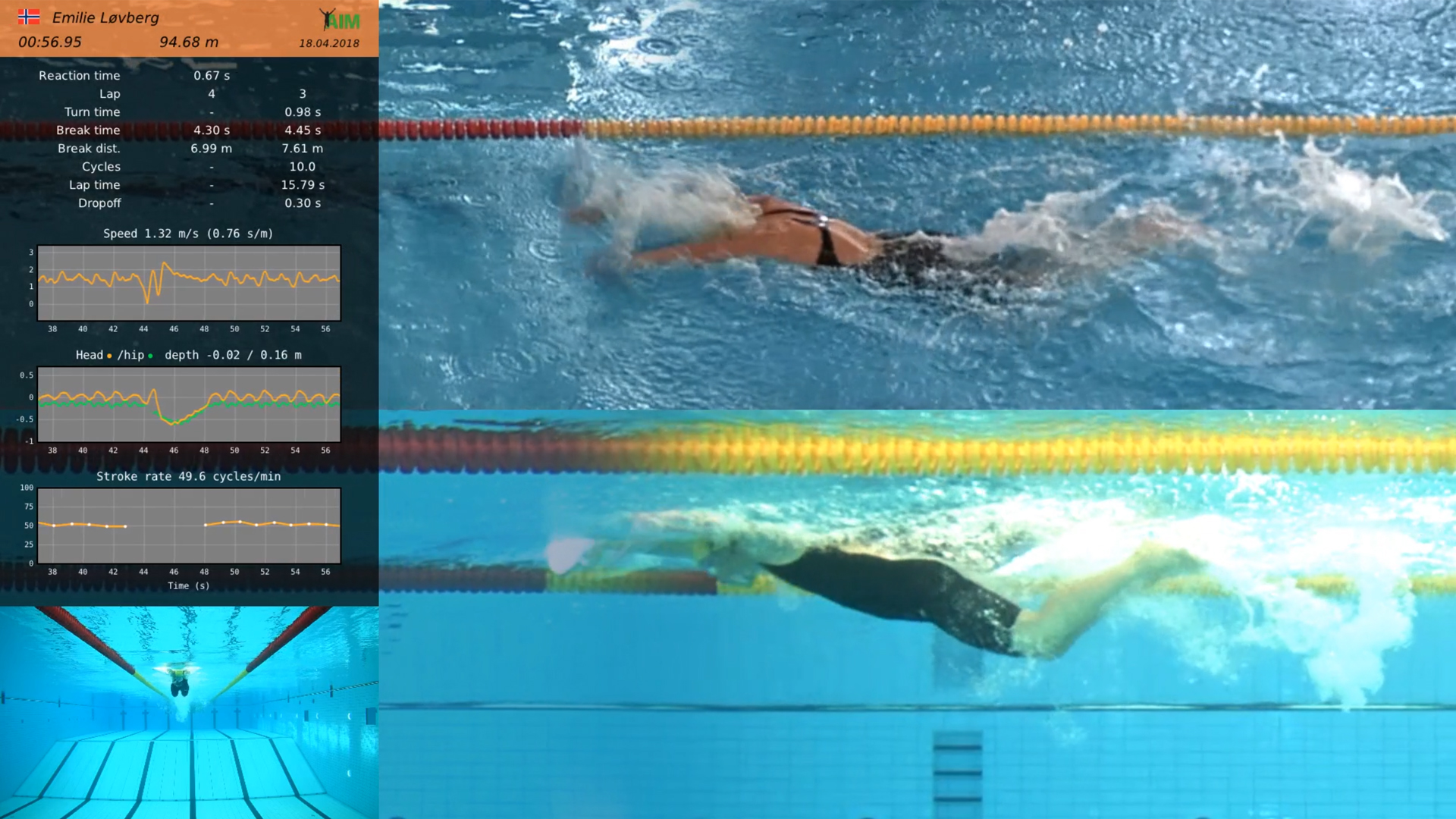
Every IM swimmer has a transition that leaks time. Butterfly-to-back. Back-to-breast. Breast-to-free. Guessing which one from the pool deck, by eye, is unreliable. Comparing turn times lap by lap is not.
Why turns matter more than coaches think
Research from the Norwegian School of Sport Sciences (Olstad et al., 2020) looked at short-course 100m breaststroke and found turns made up about 44% of total finishing time. Clean swimming was about 39%, the start about 11%, and the finish just 5%. Turns were the single biggest bucket.
The same study found 10m turn-out time was very strongly linked to overall finishing time. In other words, a slow turn doesn’t just cost you at the wall. It drags the whole segment down with it.
What “turn time” actually measures
AIM Systems captures turn time as head-entry-to-push-off for freestyle and backstroke, and hand-touch-to-push-off for breaststroke and butterfly. It also logs breakout time and breakout distance right after each push-off.
In an IM, that means four separate turn measurements per 100m swim, plus breakouts. Stack those against a swimmer’s own past times, and the weak transition stands out immediately. Maybe the fly-to-back turn is consistently 0.3 seconds slower than the swimmer’s best. Maybe breakout distance shrinks specifically on the breast-to-free wall.
The same research found something coaches often miss: turn-out time got progressively slower across a race, by about 0.38 seconds from first turn to last. The cause wasn’t a slower pivot at the wall — it was a weaker push-off and a shorter breakout. That’s a fatigue-and-technique issue, not a timing issue, and it shows up clearly when breakout distance is tracked turn by turn.
Turning data into a training fix
Once a coach knows which transition is slow, the fix gets specific. A weak push-off on the fly-to-back wall might mean more dryland leg power work. A short breakout on breast-to-free might mean the swimmer is surfacing too early instead of riding the underwater phase.
- Compare each IM turn against the swimmer’s personal-best turn times, lap by lap.
- Watch breakout distance specifically on the transition turns, not just the finish-stroke turns.
- Retest the same transition after a training block to confirm the fix actually worked.
Because AIM Systems’ cameras track the swimmer through the entire race — above and below water — this data comes out of every automated capture without extra stopwatch work. Setup takes about two minutes. For a 100m race, the stitched video and full data spreadsheet are ready in about four minutes.
That means a coach can pull up all four IM turns from that morning’s swim before the swimmer’s even done with the cool-down, and start the conversation about which wall needs the most attention next.
If you want to see how this looks with your own IM swimmers, get in touch with AIM Systems — happy to walk through it.
Frequently asked questions
How do you know which IM transition is slowing a swimmer down?
Compare turn time and breakout distance at each of the four IM walls against the swimmer’s own past best times to see which one lags.
Why do turn times get slower later in a race?
Research on short-course breaststroke found turn-out time slows progressively through a race mainly due to a weaker push-off and shorter breakout, not a slower pivot.
What does AIM Systems measure at each IM turn?
It measures turn time, breakout time, and breakout distance at every wall, then lets a coach compare those against personal-best times lap by lap.
Sources
- Olstad, B.H., Wathne, H., & Gonjo, T. (2020). Key Factors Related to Short Course 100 m Breaststroke Performance. International Journal of Environmental Research and Public Health, 17(17), 6257. https://doi.org/10.3390/ijerph17176257
- Seifert, L., Conceição, A., Gonjo, T., Šťastný, J., & Olstad, B.H. (2021). Arm-leg coordination profiling during the dolphin kick and the arm pull-out in elite breaststrokers. Journal of Sports Sciences. https://doi.org/10.1080/02640414.2021.1950446
Social Contact