
Breakout distance — the distance a swimmer travels underwater off the wall before the head breaks the surface — is one of the most coachable and most under-measured numbers in a race. Most programs eyeball it from the pool deck or, at best, get a rough split-time estimate from a stopwatch. That’s not precise enough to actually change anything.
Here’s the fresh angle worth trying this week: instead of tracking breakout distance as a single race-day stat, track its variance across a swimmer’s last 10 races. A swimmer whose breakout distance swings between 4.5m and 7m race to race doesn’t have a technique problem — they have a decision-making problem. They’re guessing how many kicks to take underwater instead of executing a rehearsed, fatigue-tested plan. Fixing that variance is often worth more time than fixing the kick itself.
Why variance matters more than the average
A swimmer who consistently breaks out at 6m every race is predictable and coachable — you know exactly what to drill. A swimmer who averages 6m but ranges from 4m to 8m is unpredictable under race pressure, and that inconsistency usually shows up exactly when it costs the most: the third turn of a 200, or the final wall of a relay leg. Underwater phase is where technical fatigue first appears, before it’s visible in stroke rate or split times. If a swimmer’s breakout distance shrinks by a meter or more between an early-race turn and a late-race turn, that’s a measurable sign their underwater mechanics are breaking down before their arms even show it.
Why this has been hard to measure
The reason most coaches don’t track breakout variance is that it requires frame-accurate video review of every turn, every race, logged consistently over a season — and that’s tedious enough that it rarely happens. Wearable sensors don’t help here either, since nothing is worn underwater during competition, and marker-based systems require setup that’s impractical outside a lab.
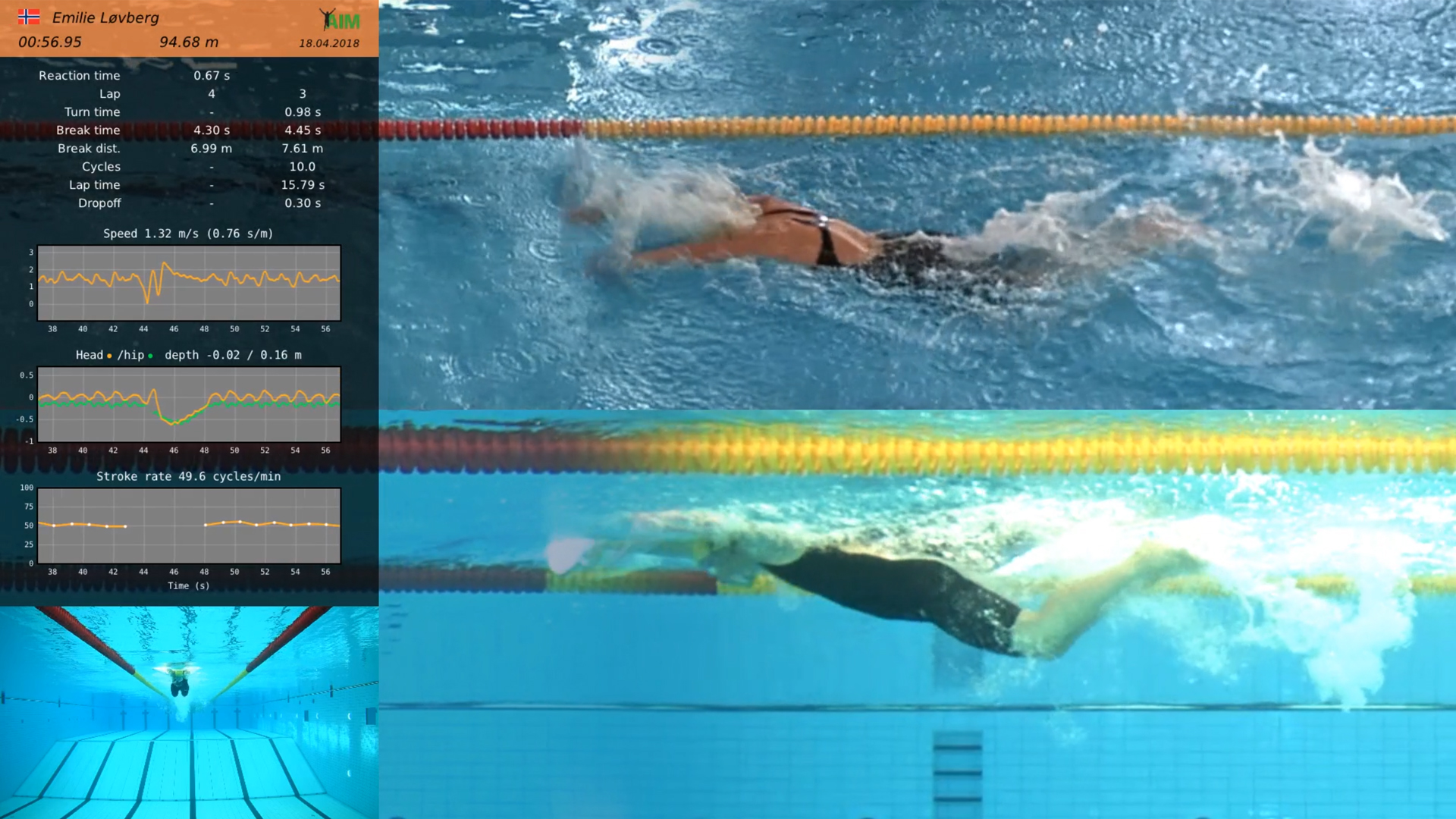
This is exactly the kind of measurement where AIM Systems’ markerless, camera-only tracking earns its keep. Because it reads stroke mechanics, kick count, breakout distance, and entry angle straight from race or practice footage — no sensors, no markers — a coach can pull breakout distance for every turn a swimmer has made this season and see the pattern instantly instead of reconstructing it by hand. That same data feeds into personal best tracking and wall velocity analysis, so you can see whether a shrinking breakout distance actually correlates with a slower wall time, or whether it’s noise.
What to do with the data
- Pull breakout distance for a swimmer’s last 8-10 competitive turns, not just their best swim.
- Flag any turn where breakout distance drops more than 15% from that swimmer’s own season average — that’s your technical fatigue signal.
- Standardize a kick-count target per event and drill it until race-day variance shrinks, not just the average distance.
Once variance drops, you’ll usually see the average improve on its own — a swimmer who trusts their underwater plan stops second-guessing it mid-race.
If you want to see what this looks like with your own team’s footage, get in touch with AIM Systems — no pressure, just a conversation about what’s practical for your program.
Social Contact