
Breakout distance fatigue is one of the most reliable signals of how a swimmer is holding up late in a race. Breakout distance is how far a swimmer travels underwater off the wall before their head surfaces. Early in a race, that distance is usually long and consistent. By the final laps, it often shrinks, and that shrinkage tells you exactly where fatigue is showing up.
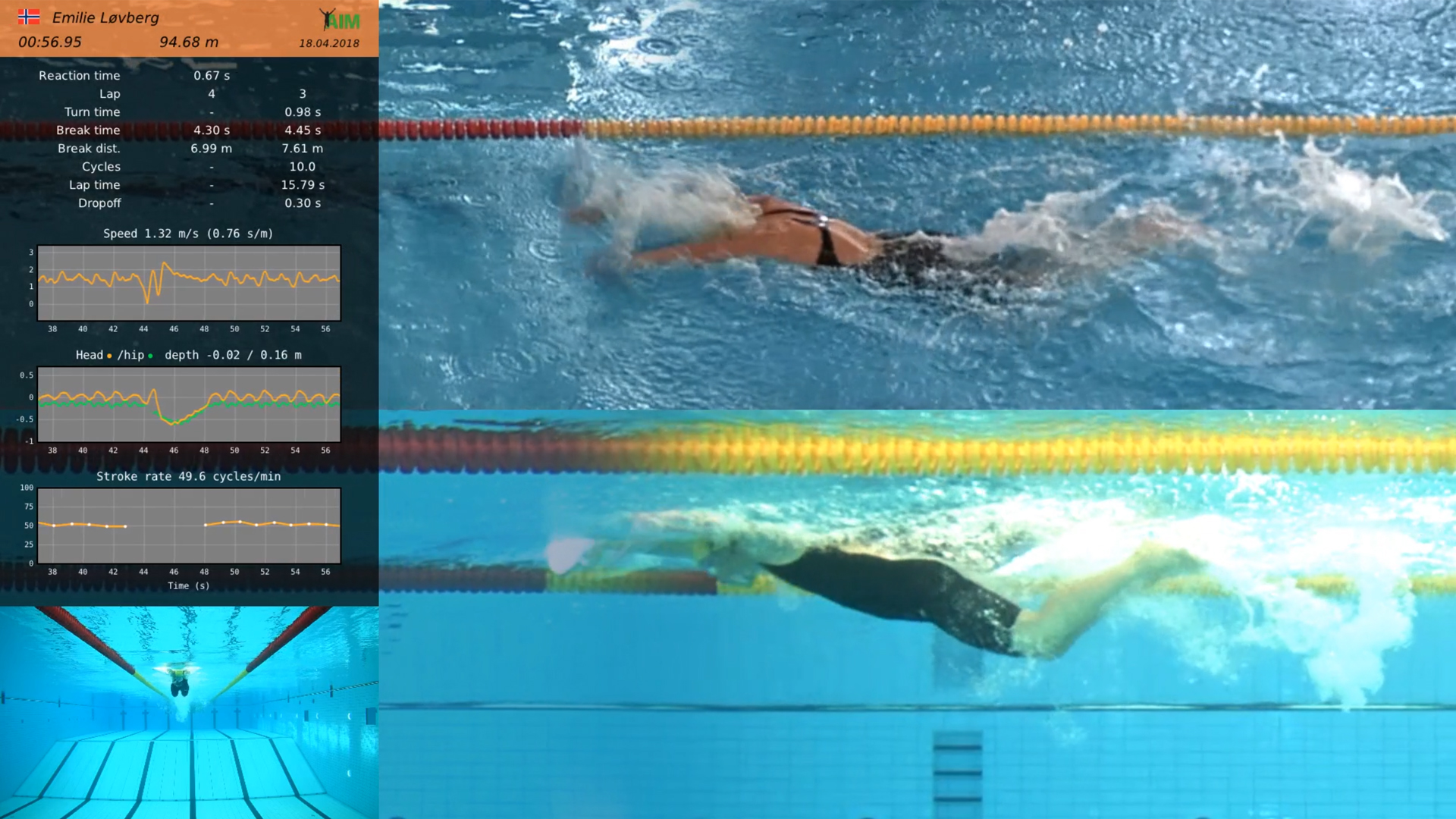
Why does this happen? Underwater phases are propelled almost entirely by kick, and kick is expensive. As lactate builds and leg strength drops, swimmers can’t hold a strong underwater dolphin kick for as long. They surface earlier, take more strokes to finish the lap, and lose time they didn’t even notice they were losing.
Why Breakout Distance Shrinks Under Fatigue
A tired swimmer often keeps their turn time steady because the wall push-off is muscle memory. What falls apart is the twenty-plus feet after it. Coaches watching from the deck usually catch the obvious signs, like slower stroke rate or a sloppier turn. Breakout distance fatigue is subtler. It’s a few feet lost here and there, repeated over eight or sixteen laps, and it adds up fast.
This is exactly the kind of change that’s hard to catch by eye but easy to catch with cameras. AIM Systems measures breakout distance and breakout time on every single lap of a capture, not just off the start. That means a coach can pull up the full race and see the trend line: breakout distance holding steady through lap 4, then dropping on laps 5 through 8 as the swimmer fatigues.
Turning a Trend Into a Training Target
Once you can see the pattern, you can train against it. If breakout distance falls off a cliff starting on a specific lap, that’s your marker. It tells you where to add underwater kick sets, or where to build race-pace repeats that specifically hold underwater technique under fatigue instead of just holding stroke count.
It also gives you a way to measure whether that training is working. AIM Systems lets a coach compare a swim lap-by-lap against that same swimmer’s own past best times, so you’re not guessing whether breakout distance improved. You can see it, lap by lap, next to the older race.
- Breakout distance usually peaks in the first 1-2 laps of a race.
- A consistent drop of more than a foot per lap after the midpoint often signals leg fatigue, not technique breakdown.
- Stroke count typically rises on the same laps where breakout distance falls, since the swimmer is spending more of the lap swimming instead of gliding underwater.
None of this requires special gear on the swimmer. AIM Systems tracks breakout distance, stroke count, lap time, and dropoff automatically, camera-only, with no sensors or markers needed. The system produces a stitched video with the data overlaid, plus a full spreadsheet, so you can review the whole race afterward instead of trying to eyeball it from the pool deck in real time.
If you’re curious what this looks like with your own swimmers, get in touch with AIM Systems. We’re happy to walk through a sample capture.
Frequently asked questions
What is breakout distance in swimming?
Breakout distance is how far a swimmer travels underwater off a wall or start before their head surfaces.
Why does breakout distance get shorter later in a race?
Underwater kicking is leg-intensive, so as fatigue builds swimmers can’t sustain the kick as long and surface earlier.
How does AIM Systems measure breakout distance?
AIM Systems uses camera-only tracking to measure breakout distance and breakout time automatically on every lap, with no sensors or markers on the swimmer.
Social Contact