
Camera-only swim analytics measures stroke mechanics and race data without putting anything on the swimmer. Wearable systems need a sensor charged, strapped on, and synced before every session. That difference alone explains why more clubs are rethinking their setup.
Wearable trackers like TritonWear or FORM have real value. They give swimmers real-time feedback during a set, and that’s genuinely useful for solo training. But they depend on a device staying on the wrist or in the goggle, staying charged, and syncing correctly. Lose one sensor in a squad of 20, and you’ve lost that swimmer’s data for the day.
Camera-based systems remove that failure point entirely. AIM Systems uses 11 fixed cameras — 5 above water, 5 below, plus one angled camera at the start — to track a swimmer without any wearable, marker, or special cap. The swimmer just swims. Nothing to charge, nothing to forget, nothing to fall off mid-turn. This set up is for a 25m pool, in a 50m pool the setup is 10 above and 10 below+ optional 2 at the turn and start side.
What Camera-Only Tracking Actually Captures
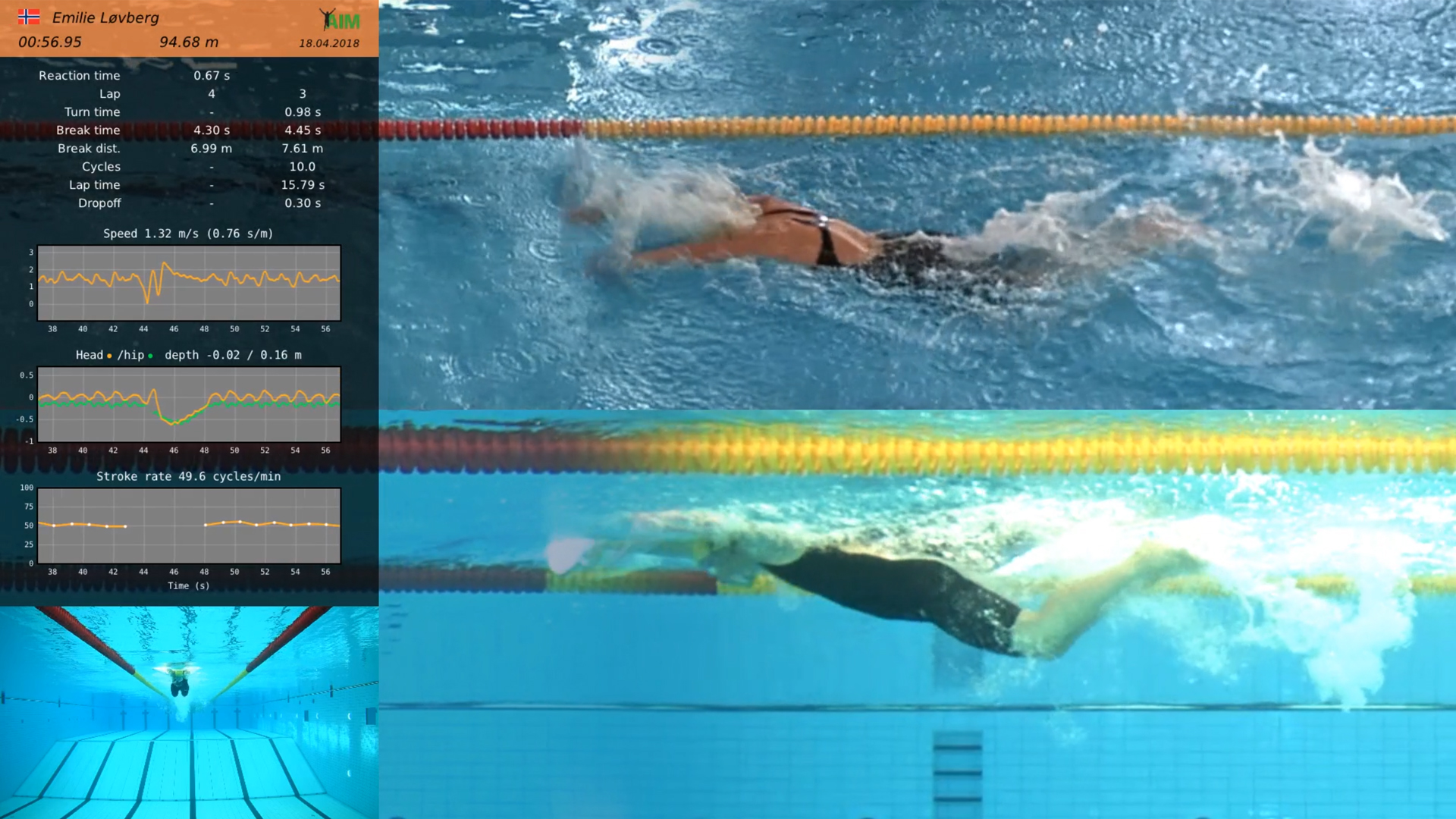
This isn’t just about convenience. Underwater cameras see things a wrist-mounted sensor simply can’t. AIM Systems tracks turn time, breakout time and distance, stroke count, stroke rate, and lap-over-lap dropoff — all pulled directly from video, not inferred from motion data.
It also measures start entry distance and underwater speed off the block, plus continuous graphs of horizontal speed and head/hip depth through the whole swim. Wearables can estimate stroke rate from arm motion. They can’t tell you where a swimmer’s head surfaces after a breaststroke pull-out, or how deep their hips ride through a turn.
That’s the real gap between the two approaches. Wearables measure the swimmer’s motion. Camera-only systems measure the swimmer’s position and technique in the water — the underwater phase, the turn, the wall.
Why Clubs Are Making the Switch
AIM Systems runs on a standard Omega timing system already installed at the pool, using touchpad data for timing. There’s no extra gear to distribute, charge, or replace each season. After the swimmer finishes, the software automatically processes the video and produces the stitched analysis video, data overlays and complete statistics. A 50 m race is ready within approximately 2 minutes and a 100 m race within approximately 4 minutes.
Coaches also get built-in comparison: a swim measured against that same swimmer’s past best times, another swimmer’s times, or a manually entered reference. That’s personal-best tracking done lap-by-lap, not a single overall score.
One real constraint worth naming honestly: AIM Systems tracks one swimmer in one lane at a time, and it’s a fixed installation — it doesn’t travel to meets. It’s built for training-facility analysis, not meet-day logistics. Facilities like Kuortane Olympic Training Center, INCEP Paris, the Norwegian Institute of Sport, and SCAR in Lund use it exactly that way — for repeatable, precise technique work at home.
Camera-Only Isn’t a Replacement, It’s a Third Category
The real framing isn’t “cameras versus wearables.” It’s meet-ops software, wearable training sensors, and now markerless camera-based analysis — three different tools for three different jobs. Camera-only systems win when precision on turns, breakouts, and stroke mechanics matters more than in-the-moment wearable feedback.
If your club is weighing which category actually fits your training environment, it’s worth a real look at the footage and data side by side.
Want to see how it works in a real pool? Get in touch with AIM Systems and we’ll walk you through it.
Frequently asked questions
What is camera-only swim analytics?
It’s a tracking method that uses fixed pool cameras instead of wearable sensors to measure stroke mechanics, turns, and race data without any device on the swimmer.
Is camera-based swim tracking more accurate than wearables?
For underwater phases, turns, and breakouts, camera systems capture position and depth data that wrist- or goggle-mounted wearables can’t directly measure.
Does AIM Systems replace wearable swim trackers?
No, it’s a different category built for precise technique and race analysis at a fixed training facility, not for real-time in-set feedback.
Social Contact