
Spreadsheets can store swim data. They can’t generate it. That’s the real difference between Excel and race analytics software, and it’s why the comparison usually made — spreadsheets vs. software for rosters, billing, attendance — misses the point for anyone trying to analyze actual performance. FINA points, wall velocity, and stroke mechanics aren’t data entry problems. They’re measurement problems, and a spreadsheet has no way to measure anything.
Take FINA points (now World Aquatics points). The calculation itself is simple math — a base time, a power function, done in a cell in seconds. But the input has to come from somewhere. If a coach is hand-timing splits, transcribing them post-session, then plugging them into a formula, the “real-time” part is gone before the spreadsheet even opens. By the time the points are calculated, the swimmer has already left the pool and the coaching moment is over.
Wall velocity is where the gap becomes obvious. Calculating velocity into and out of a wall requires frame-accurate position data at the turn — distance covered per frame, not per lap. A stopwatch or a manual split can’t produce that. There’s no column in Excel for “position of the swimmer’s hip at 0.04-second intervals.” That data doesn’t exist unless something captured it, and nothing about a spreadsheet captures anything. It only holds what’s already been measured elsewhere, by someone else, with some other tool.
Stroke mechanics: the data spreadsheets were never built to hold
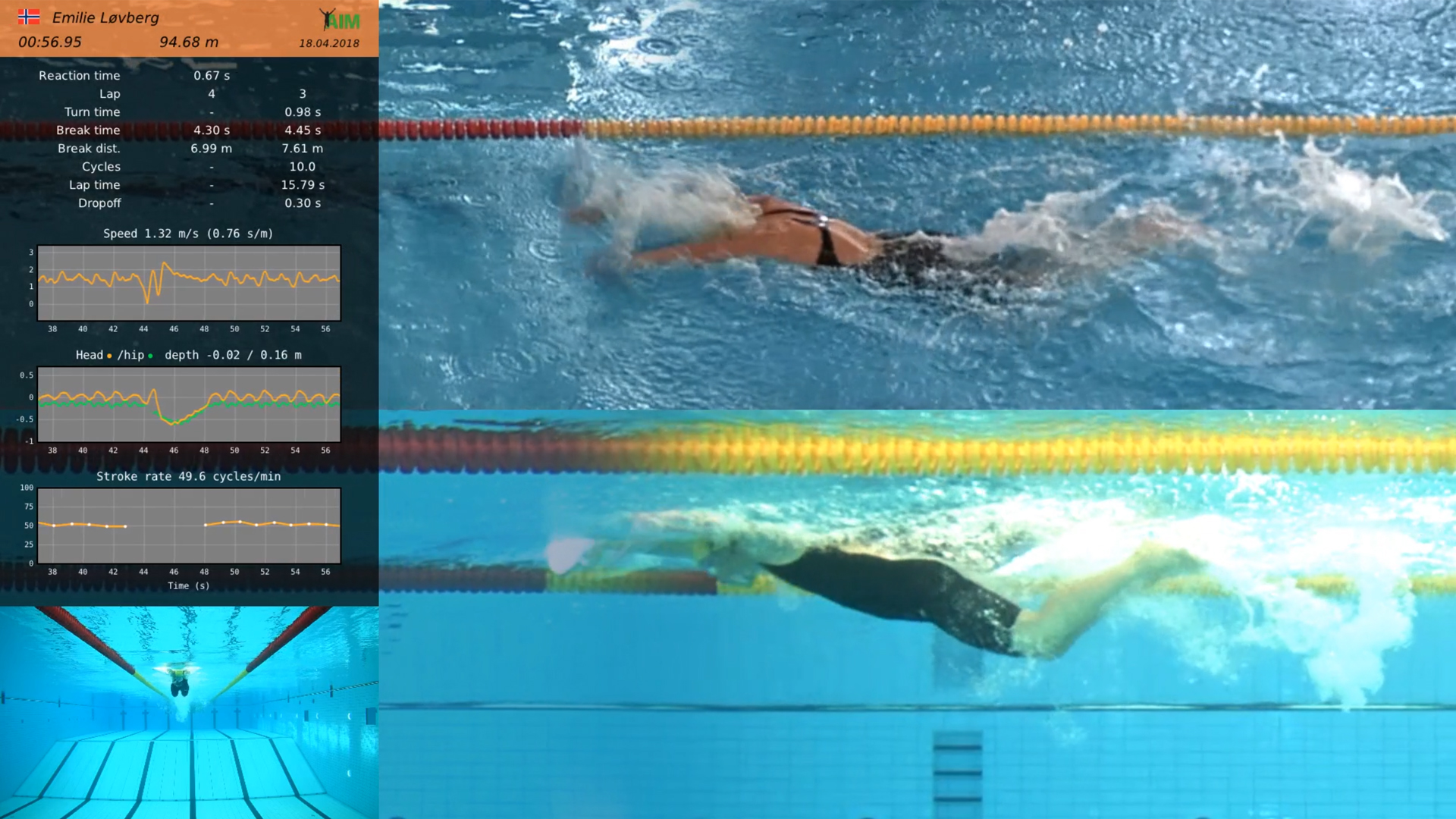
Stroke count, breakout distance, entry angle, kick count off the wall — these live in the underwater phase of the race, and they change second to second as a swimmer fatigues. No coach is going to sit poolside with a spreadsheet open, typing entry angles in real time while also running a session. This is exactly the gap AIM Systems was built to close: markerless, camera-only tracking that reads stroke mechanics directly from footage — no wearables, no sensors, no markers on the swimmer. The camera sees what a spreadsheet can only ever be told about, secondhand and after the fact.
This matters most for technical fatigue — the breakdown in stroke mechanics under load that’s often the actual limiter in a race, more than raw fitness. You can see it in footage: stroke length shortening, entry angle changing, kick count dropping off in the back half. A spreadsheet has no lens on that. It can hold a final time and maybe a manually-logged stroke count, but it can’t show you where or why the mechanics broke down.
AIM Systems runs the full pipeline — swim, then exported film with data overlays and a complete dataset — in under two minutes, with no manual processing. That’s not a faster spreadsheet. It’s a different category of tool, built for the same reason broadcast overlays exist: because coaches and swimmers need to see the race, not just its final number. The system is already in use at Kuortane Olympic Training Center in Finland, INCEP Paris, the Norwegian Institute of Sport, and SCAR in Lund — environments where “log it later” isn’t good enough.
None of this makes spreadsheets useless. They’re still fine for meet entries, roster tracking, season planning. But if the question is whether Excel can calculate FINA points, wall velocity, or stroke mechanics in real time, the honest answer is no — because it was never built to capture the data those calculations depend on.
If you’re curious what your own footage could show with proper tracking behind it, get in touch with AIM Systems — no pressure, just a conversation about what’s possible.
Social Contact